
Quinn Dyer.
NYU Stern Student
“Poor is the mind that always uses the inventions of others, and invents nothing itself.”
Hieronymus Bosch — quote source, opens in a new tab
I’m Quinn, an undergraduate at NYU Stern. I’m interested in finance, economics, psychology, and building things.
Find me here, or send me an email.
Links will be added here.
Investment Management — Final
May 2026 · I helped write this exam with Professor Philip Vasan ↗ and the teaching team.
These previews show questions only. Answer keys and other restricted material are left out; obscured blocks mark the omissions.
Version A

Read text version
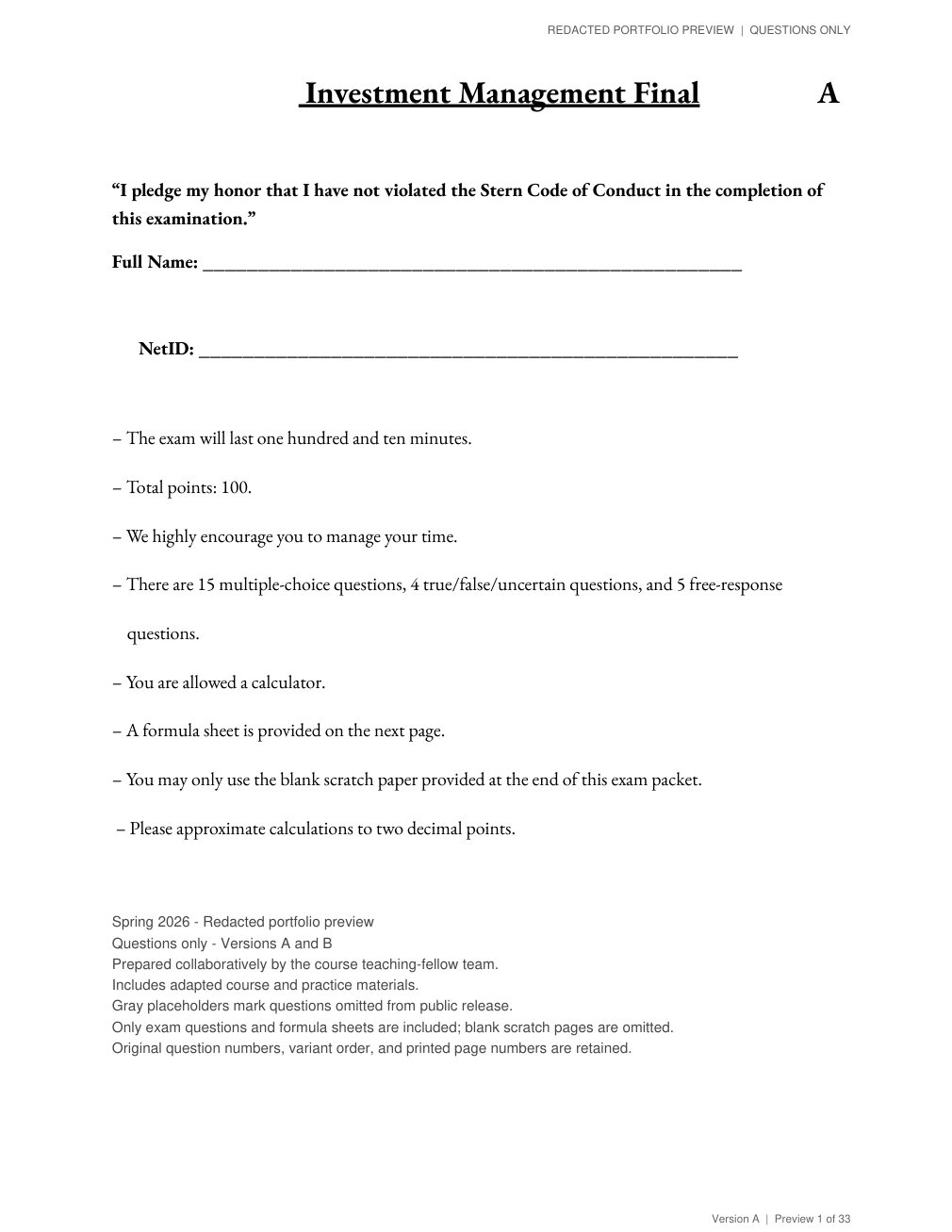
Investment Management Final A
“I pledge my honor that I have not violated the Stern Code of Conduct in the completion of
this examination.”
Full Name: _________________________________________________
NetID: _________________________________________________
– The exam will last one hundred and ten minutes.
– Total points: 100.
– We highly encourage you to manage your time.
– There are 15 multiple-choice questions, 4 true/false/uncertain questions, and 5 free-response
questions.
– You are allowed a calculator.
– A formula sheet is provided on the next page.
– You may only use the blank scratch paper provided at the end of this exam packet.
– Please approximate calculations to two decimal points.
Spring 2026 - Redacted portfolio preview
Questions only - Versions A and B
Prepared collaboratively by the course teaching-fellow team.
Includes adapted course and practice materials.
Gray placeholders mark questions omitted from public release.
Only exam questions and formula sheets are included; blank scratch pages are omitted.
Original question numbers, variant order, and printed page numbers are retained.
REDACTED PORTFOLIO PREVIEW | QUESTIONS ONLY
Version A | Preview 1 of 33
FINC-GB 2306.20
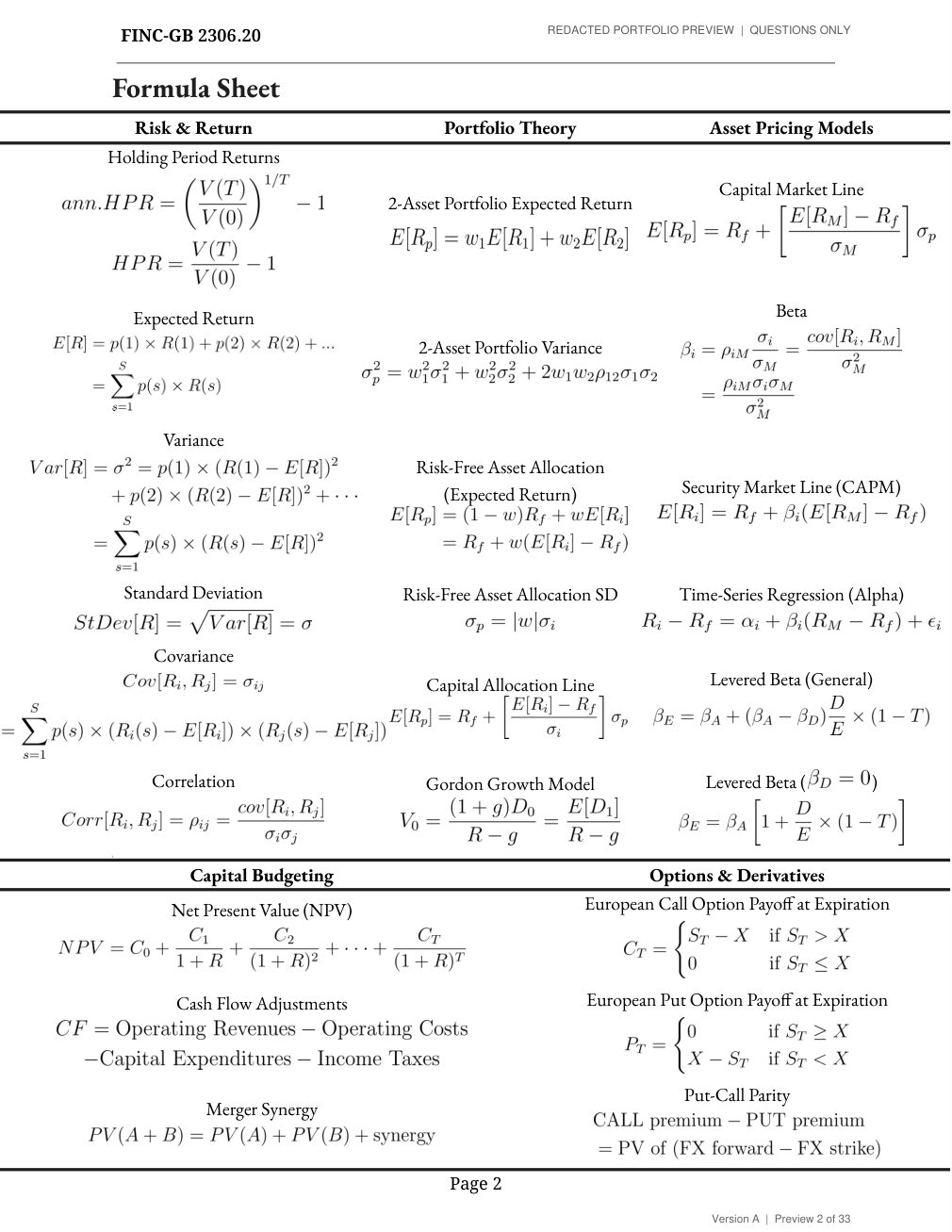
Formula Sheet
Risk & Return
Portfolio Theory
Asset Pricing Models
Holding Period Returns
2-Asset Portfolio Expected Return
Capital Market Line
Expected Return
2-Asset Portfolio Variance
Beta
Variance
Risk-Free Asset Allocation
(Expected Return)
Security Market Line (CAPM)
Standard Deviation
Risk-Free Asset Allocation SD
Time-Series Regression (Alpha)
Covariance
Capital Allocation Line
Levered Beta (General)
Correlation
Gordon Growth Model
Levered Beta (
)
\
Capital Budgeting
Options & Derivatives
Net Present Value (NPV)
European Call Option Payoff at Expiration
Cash Flow Adjustments
European Put Option Payoff at Expiration
Merger Synergy
Put-Call Parity
Page 2
REDACTED PORTFOLIO PREVIEW | QUESTIONS ONLY
Version A | Preview 2 of 33
FINC-GB 2306.20
1 Multiple-Choice Questions
30 points.
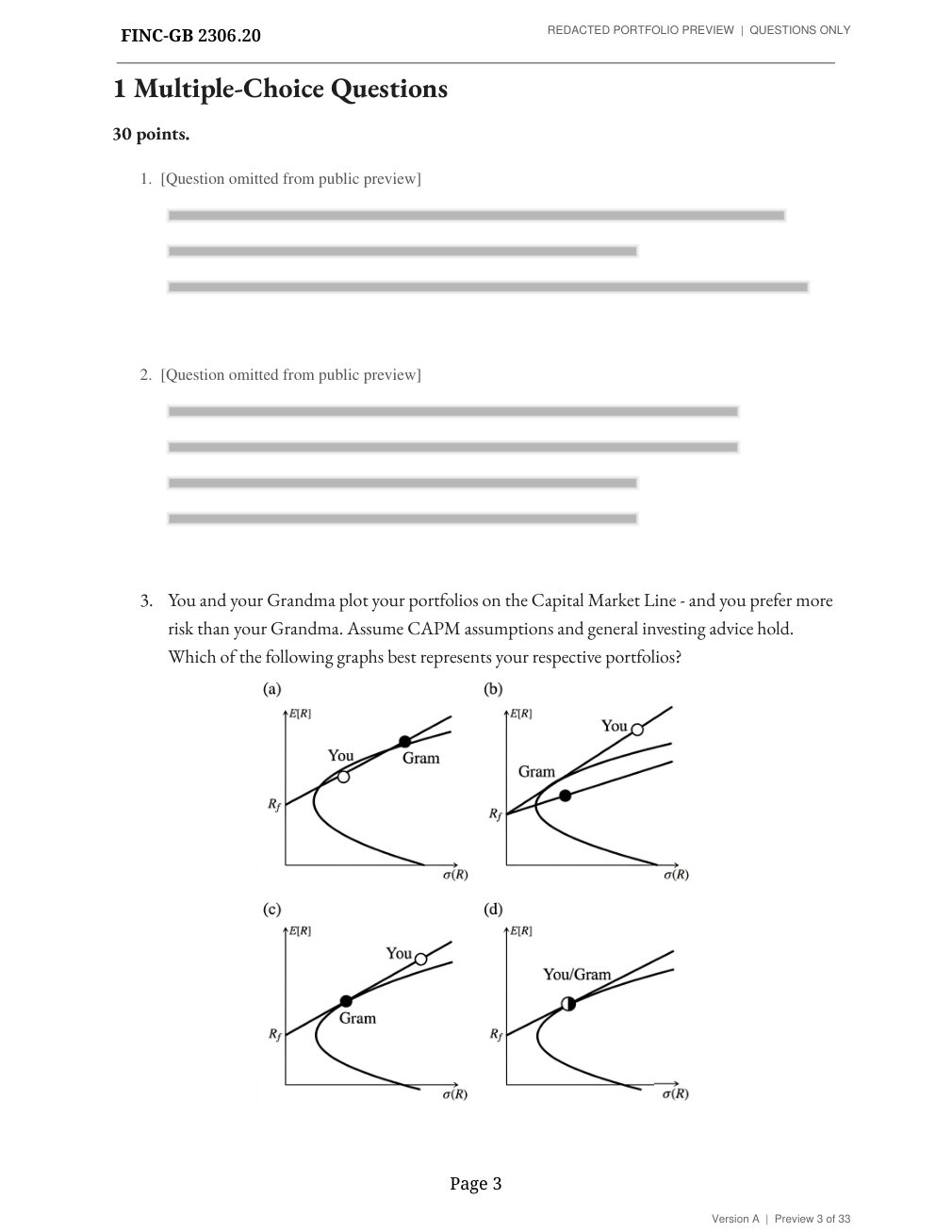
3. You and your Grandma plot your portfolios on the Capital Market Line - and you prefer more
risk than your Grandma. Assume CAPM assumptions and general investing advice hold.
Which of the following graphs best represents your respective portfolios?
Page 3
1. [Question omitted from public preview]
2. [Question omitted from public preview]
REDACTED PORTFOLIO PREVIEW | QUESTIONS ONLY
Version A | Preview 3 of 33
FINC-GB 2306.20
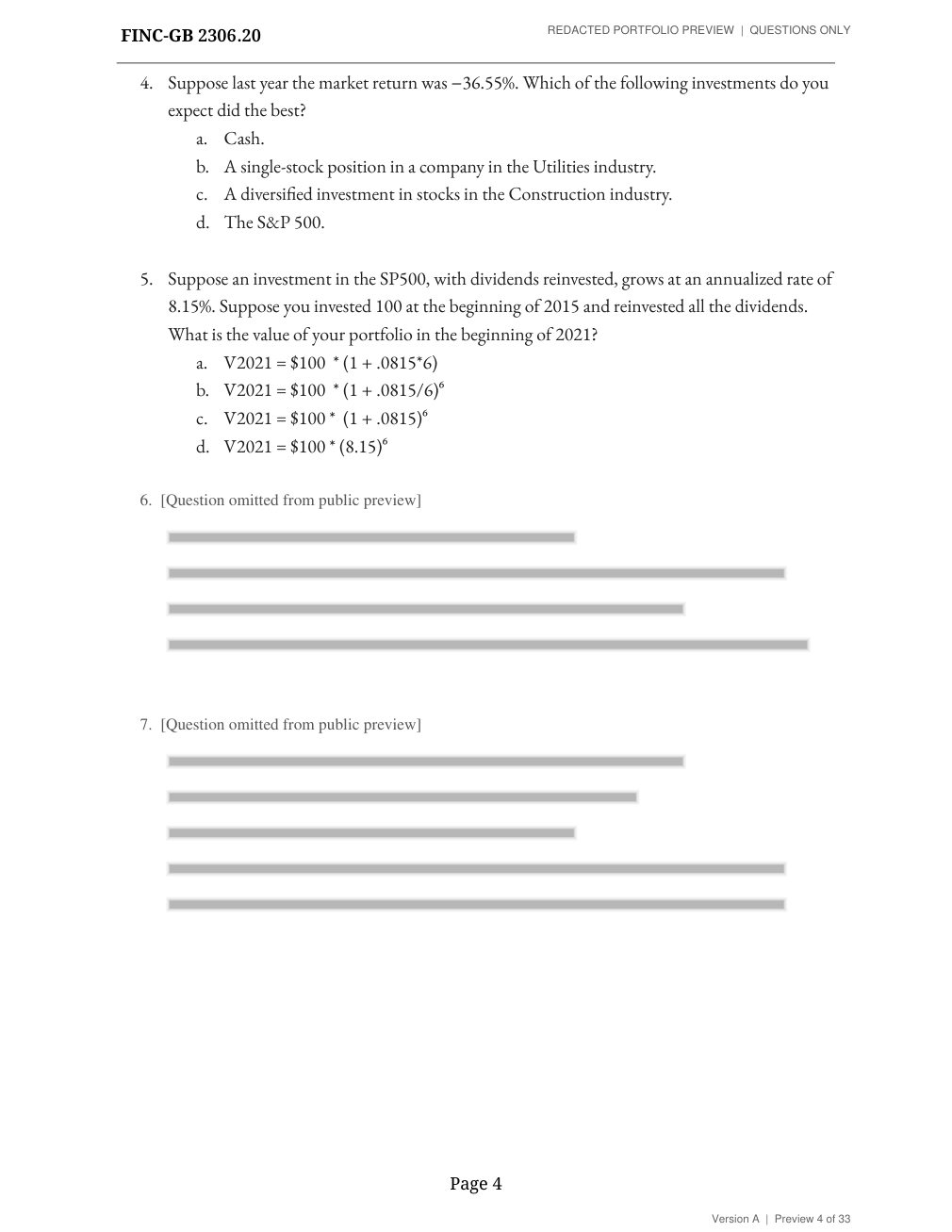
4. Suppose last year the market return was −36.55%. Which of the following investments do you
expect did the best?
a. Cash.
b. A single-stock position in a company in the Utilities industry.
c. A diversified investment in stocks in the Construction industry.
d. The S&P 500.
5. Suppose an investment in the SP500, with dividends reinvested, grows at an annualized rate of
8.15%. Suppose you invested 100 at the beginning of 2015 and reinvested all the dividends.
What is the value of your portfolio in the beginning of 2021?
a. V2021 = $100 * (1 + .0815*6)
b. V2021 = $100 * (1 + .0815/6)^6
c. V2021 = $100 * (1 + .0815)^6
d. V2021 = $100 * (8.15)^6
Page 4
6. [Question omitted from public preview]
7. [Question omitted from public preview]
REDACTED PORTFOLIO PREVIEW | QUESTIONS ONLY
Version A | Preview 4 of 33
FINC-GB 2306.20
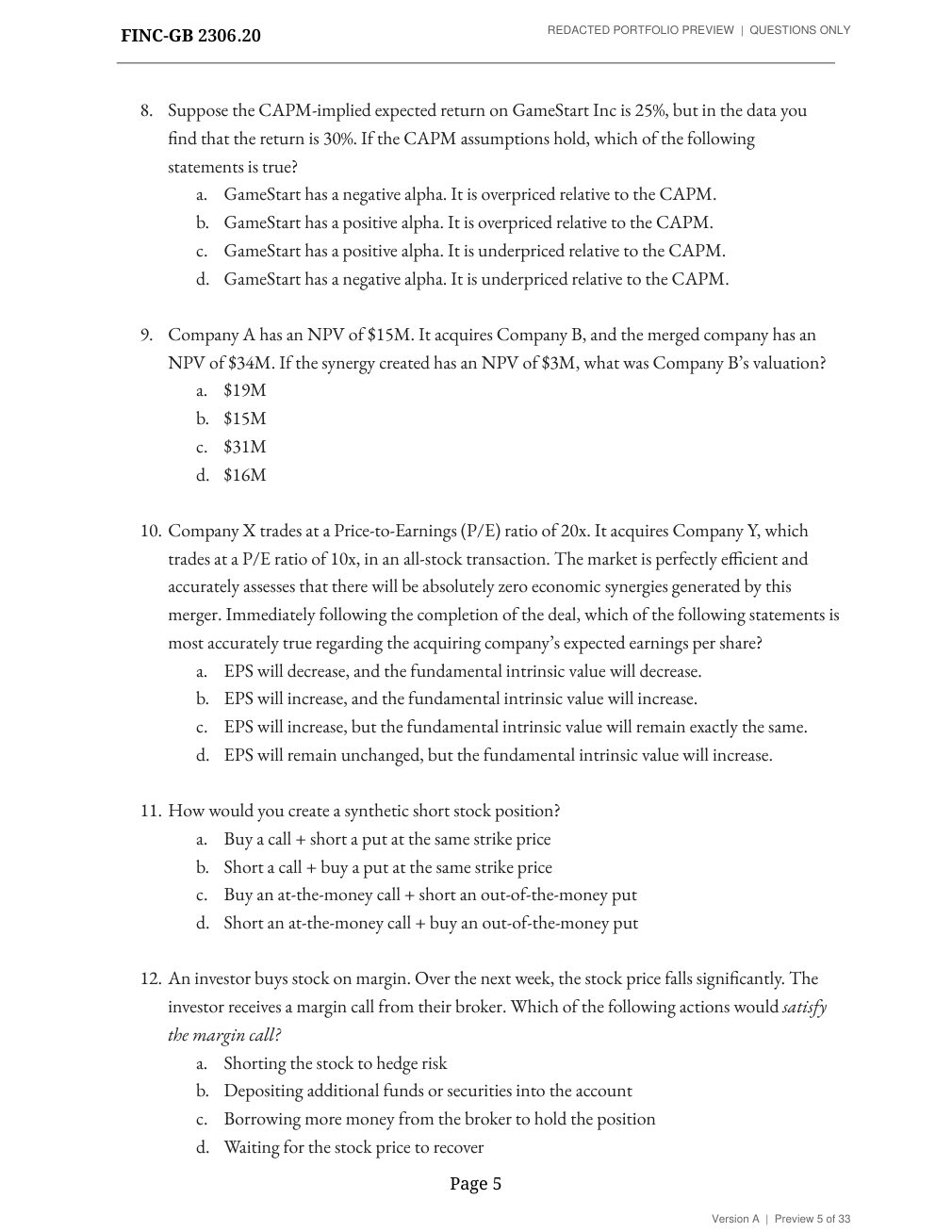
8. Suppose the CAPM-implied expected return on GameStart Inc is 25%, but in the data you
find that the return is 30%. If the CAPM assumptions hold, which of the following
statements is true?
a. GameStart has a negative alpha. It is overpriced relative to the CAPM.
b. GameStart has a positive alpha. It is overpriced relative to the CAPM.
c. GameStart has a positive alpha. It is underpriced relative to the CAPM.
d. GameStart has a negative alpha. It is underpriced relative to the CAPM.
9. Company A has an NPV of $15M. It acquires Company B, and the merged company has an
NPV of $34M. If the synergy created has an NPV of $3M, what was Company B’s valuation?
a. $19M
b. $15M
c. $31M
d. $16M
10.Company X trades at a Price-to-Earnings (P/E) ratio of 20x. It acquires Company Y, which
trades at a P/E ratio of 10x, in an all-stock transaction. The market is perfectly efficient and
accurately assesses that there will be absolutely zero economic synergies generated by this
merger. Immediately following the completion of the deal, which of the following statements is
most accurately true regarding the acquiring company’s expected earnings per share?
a. EPS will decrease, and the fundamental intrinsic value will decrease.
b. EPS will increase, and the fundamental intrinsic value will increase.
c. EPS will increase, but the fundamental intrinsic value will remain exactly the same.
d. EPS will remain unchanged, but the fundamental intrinsic value will increase.
11.How would you create a synthetic short stock position?
a. Buy a call + short a put at the same strike price
b. Short a call + buy a put at the same strike price
c. Buy an at-the-money call + short an out-of-the-money put
d. Short an at-the-money call + buy an out-of-the-money put
12.An investor buys stock on margin. Over the next week, the stock price falls significantly. The
investor receives a margin call from their broker. Which of the following actions would satisfy
the margin call?
a. Shorting the stock to hedge risk
b. Depositing additional funds or securities into the account
c. Borrowing more money from the broker to hold the position
d. Waiting for the stock price to recover
Page 5
REDACTED PORTFOLIO PREVIEW | QUESTIONS ONLY
Version A | Preview 5 of 33
FINC-GB 2306.20
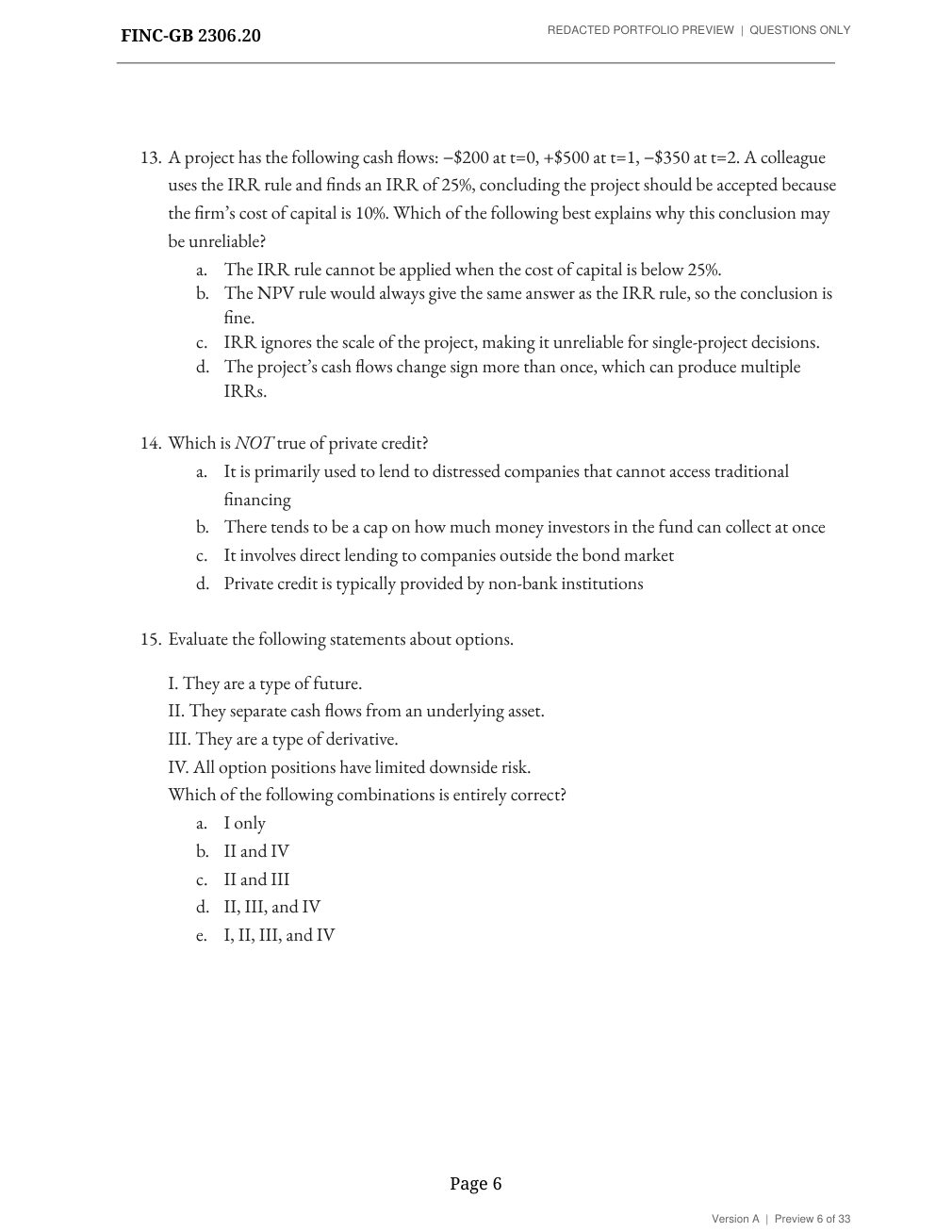
13.A project has the following cash flows: −$200 at t=0, +$500 at t=1, −$350 at t=2. A colleague
uses the IRR rule and finds an IRR of 25%, concluding the project should be accepted because
the firm’s cost of capital is 10%. Which of the following best explains why this conclusion may
be unreliable?
a. The IRR rule cannot be applied when the cost of capital is below 25%.
b. The NPV rule would always give the same answer as the IRR rule, so the conclusion is
fine.
c. IRR ignores the scale of the project, making it unreliable for single-project decisions.
d. The project’s cash flows change sign more than once, which can produce multiple
IRRs.
14.Which is NOT true of private credit?
a. It is primarily used to lend to distressed companies that cannot access traditional
financing
b. There tends to be a cap on how much money investors in the fund can collect at once
c. It involves direct lending to companies outside the bond market
d. Private credit is typically provided by non-bank institutions
15.Evaluate the following statements about options.
I. They are a type of future.
II. They separate cash flows from an underlying asset.
III. They are a type of derivative.
IV. All option positions have limited downside risk.
Which of the following combinations is entirely correct?
a. I only
b. II and IV
c. II and III
d. II, III, and IV
e. I, II, III, and IV
Page 6
REDACTED PORTFOLIO PREVIEW | QUESTIONS ONLY
Version A | Preview 6 of 33
FINC-GB 2306.20
2 True/False/Uncertain
20 points. State True or False, and provide a clear written justification of 2–4 sentences. The
justification is required for full credit.
Page 7
1. [Question omitted from public preview]
REDACTED PORTFOLIO PREVIEW | QUESTIONS ONLY
Version A | Preview 7 of 33
FINC-GB 2306.20
Page 8
2. [Question omitted from public preview]
REDACTED PORTFOLIO PREVIEW | QUESTIONS ONLY
Version A | Preview 8 of 33
FINC-GB 2306.20
Page 9
3. [Question omitted from public preview]
4. [Question omitted from public preview]
REDACTED PORTFOLIO PREVIEW | QUESTIONS ONLY
Version A | Preview 9 of 33
FINC-GB 2306.20
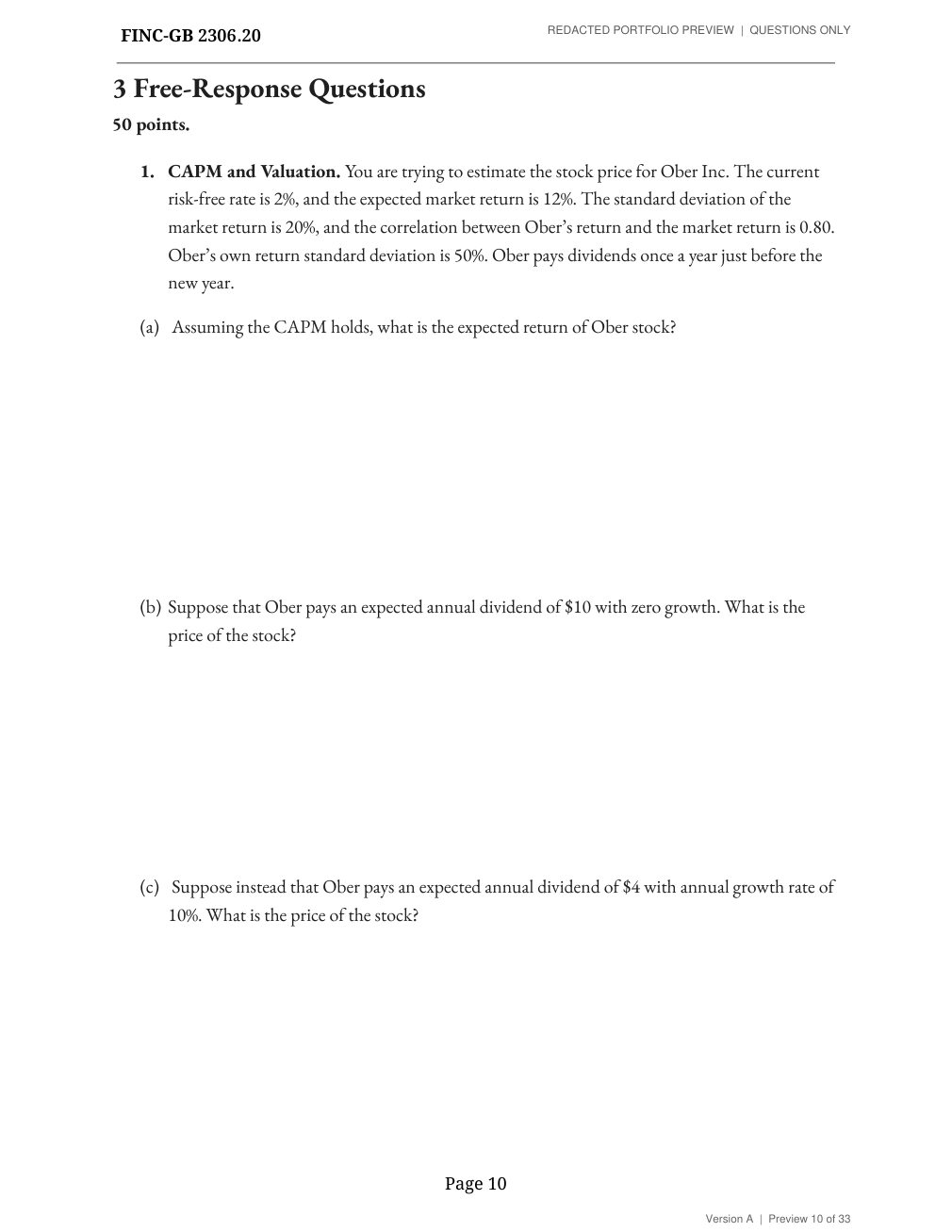
3 Free-Response Questions
50 points.
1. CAPM and Valuation. You are trying to estimate the stock price for Ober Inc. The current
risk-free rate is 2%, and the expected market return is 12%. The standard deviation of the
market return is 20%, and the correlation between Ober’s return and the market return is 0.80.
Ober’s own return standard deviation is 50%. Ober pays dividends once a year just before the
new year.
(a) Assuming the CAPM holds, what is the expected return of Ober stock?
(b) Suppose that Ober pays an expected annual dividend of $10 with zero growth. What is the
price of the stock?
(c) Suppose instead that Ober pays an expected annual dividend of $4 with annual growth rate of
10%. What is the price of the stock?
Page 10
REDACTED PORTFOLIO PREVIEW | QUESTIONS ONLY
Version A | Preview 10 of 33
FINC-GB 2306.20
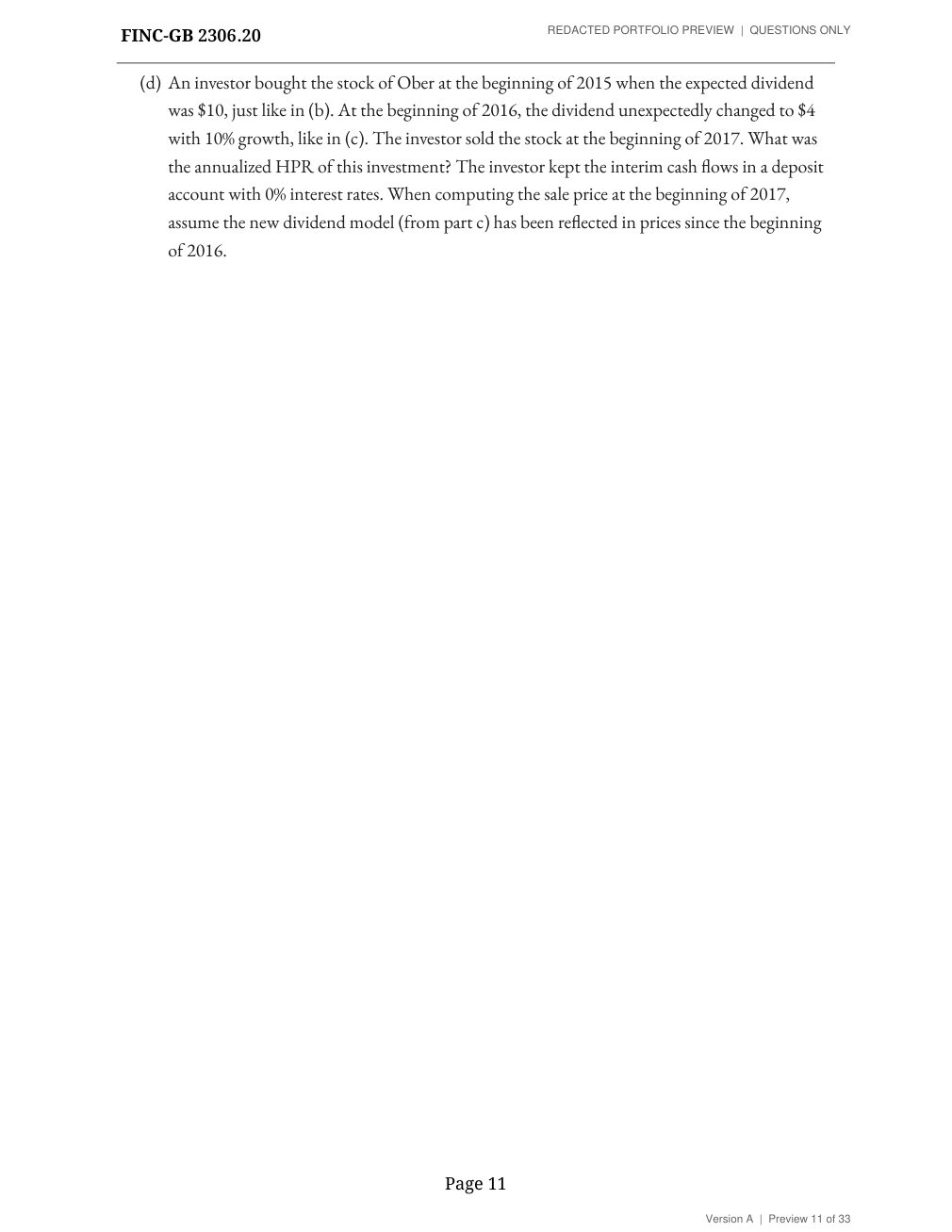
(d) An investor bought the stock of Ober at the beginning of 2015 when the expected dividend
was $10, just like in (b). At the beginning of 2016, the dividend unexpectedly changed to $4
with 10% growth, like in (c). The investor sold the stock at the beginning of 2017. What was
the annualized HPR of this investment? The investor kept the interim cash flows in a deposit
account with 0% interest rates. When computing the sale price at the beginning of 2017,
assume the new dividend model (from part c) has been reflected in prices since the beginning
of 2016.
Page 11
REDACTED PORTFOLIO PREVIEW | QUESTIONS ONLY
Version A | Preview 11 of 33
FINC-GB 2306.20
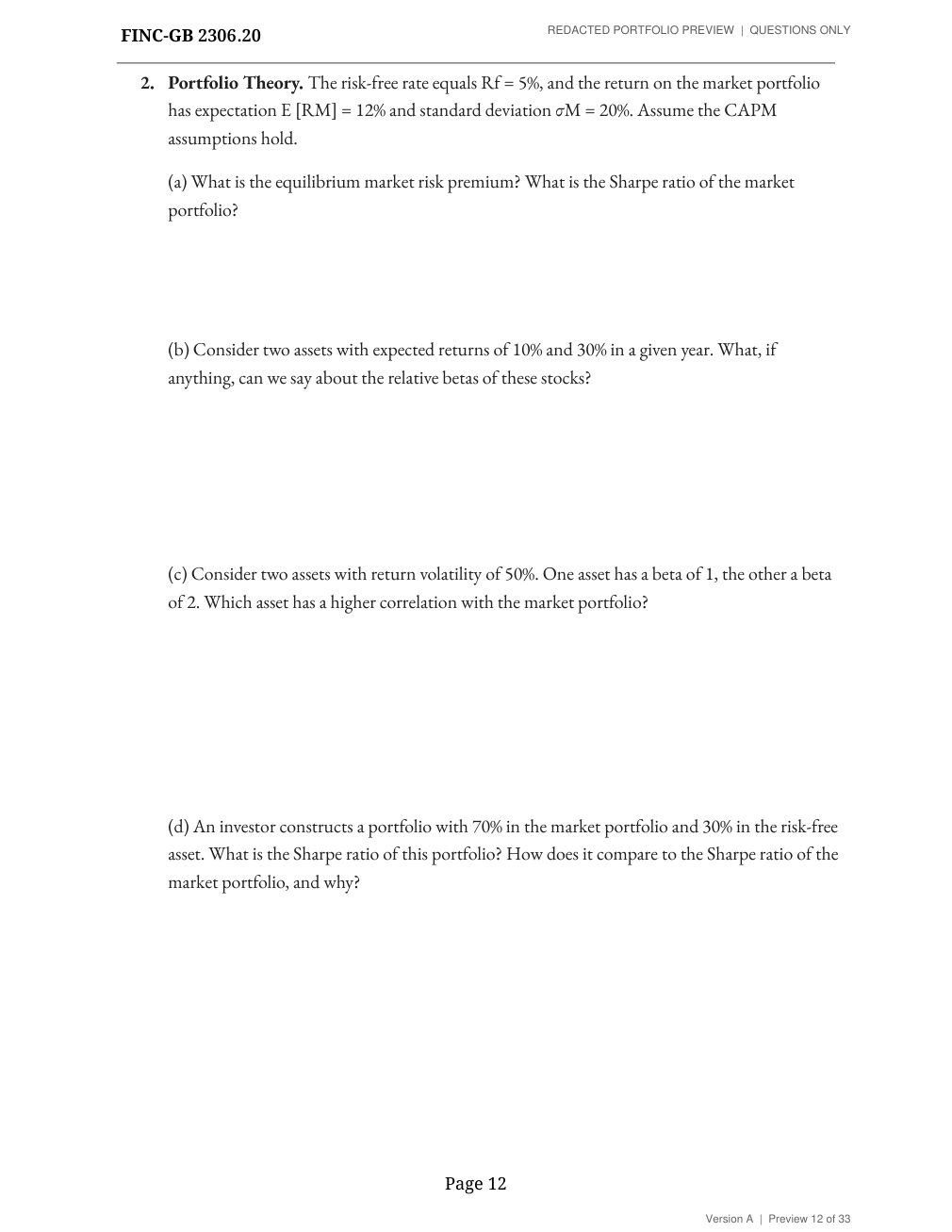
2. Portfolio Theory. The risk-free rate equals Rf = 5%, and the return on the market portfolio
has expectation E [RM] = 12% and standard deviation σM = 20%. Assume the CAPM
assumptions hold.
(a) What is the equilibrium market risk premium? What is the Sharpe ratio of the market
portfolio?
(b) Consider two assets with expected returns of 10% and 30% in a given year. What, if
anything, can we say about the relative betas of these stocks?
(c) Consider two assets with return volatility of 50%. One asset has a beta of 1, the other a beta
of 2. Which asset has a higher correlation with the market portfolio?
(d) An investor constructs a portfolio with 70% in the market portfolio and 30% in the risk-free
asset. What is the Sharpe ratio of this portfolio? How does it compare to the Sharpe ratio of the
market portfolio, and why?
Page 12
REDACTED PORTFOLIO PREVIEW | QUESTIONS ONLY
Version A | Preview 12 of 33
FINC-GB 2306.20
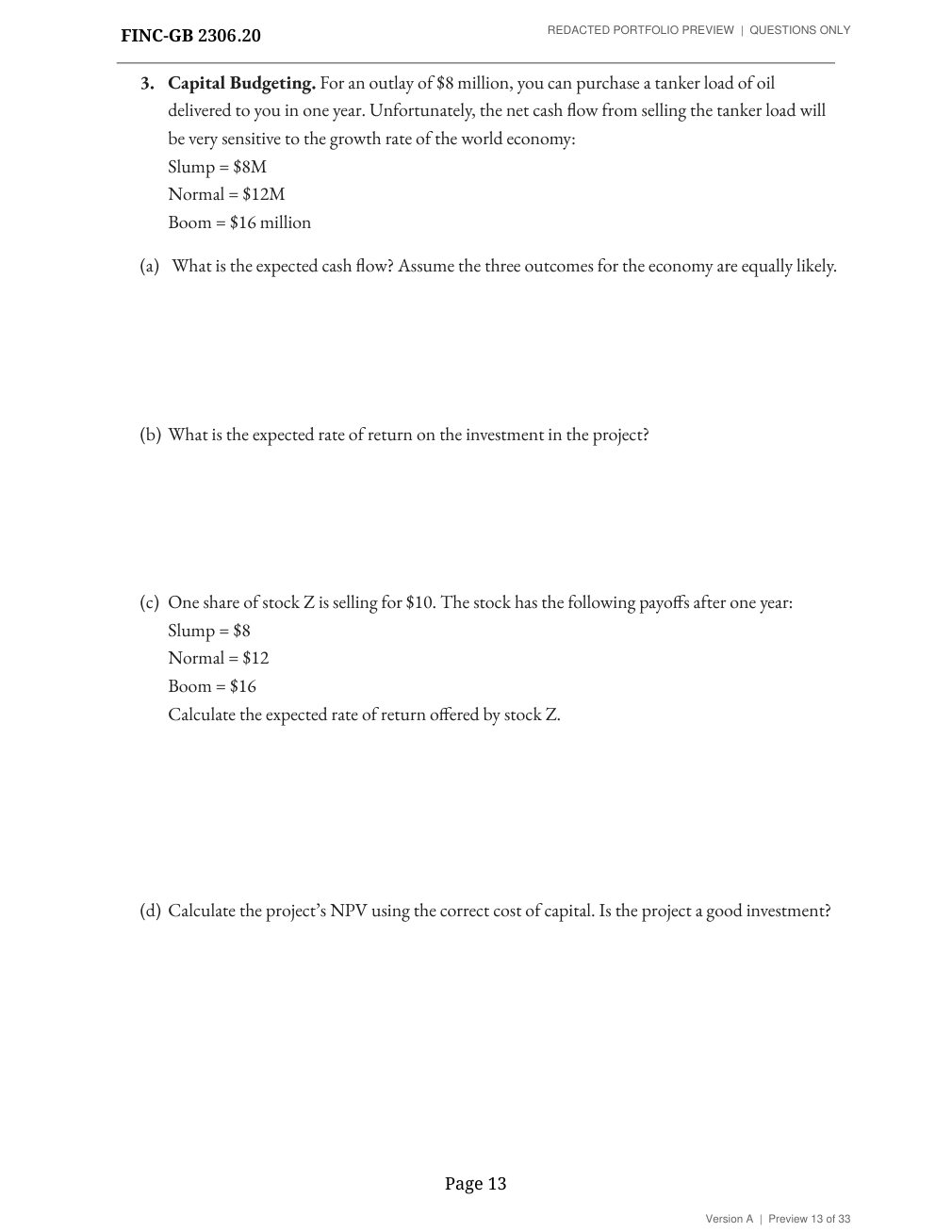
3. Capital Budgeting. For an outlay of $8 million, you can purchase a tanker load of oil
delivered to you in one year. Unfortunately, the net cash flow from selling the tanker load will
be very sensitive to the growth rate of the world economy:
Slump = $8M
Normal = $12M
Boom = $16 million
(a) What is the expected cash flow? Assume the three outcomes for the economy are equally likely.
(b) What is the expected rate of return on the investment in the project?
(c) One share of stock Z is selling for $10. The stock has the following payoffs after one year:
Slump = $8
Normal = $12
Boom = $16
Calculate the expected rate of return offered by stock Z.
(d) Calculate the project’s NPV using the correct cost of capital. Is the project a good investment?
Page 13
REDACTED PORTFOLIO PREVIEW | QUESTIONS ONLY
Version A | Preview 13 of 33
FINC-GB 2306.20
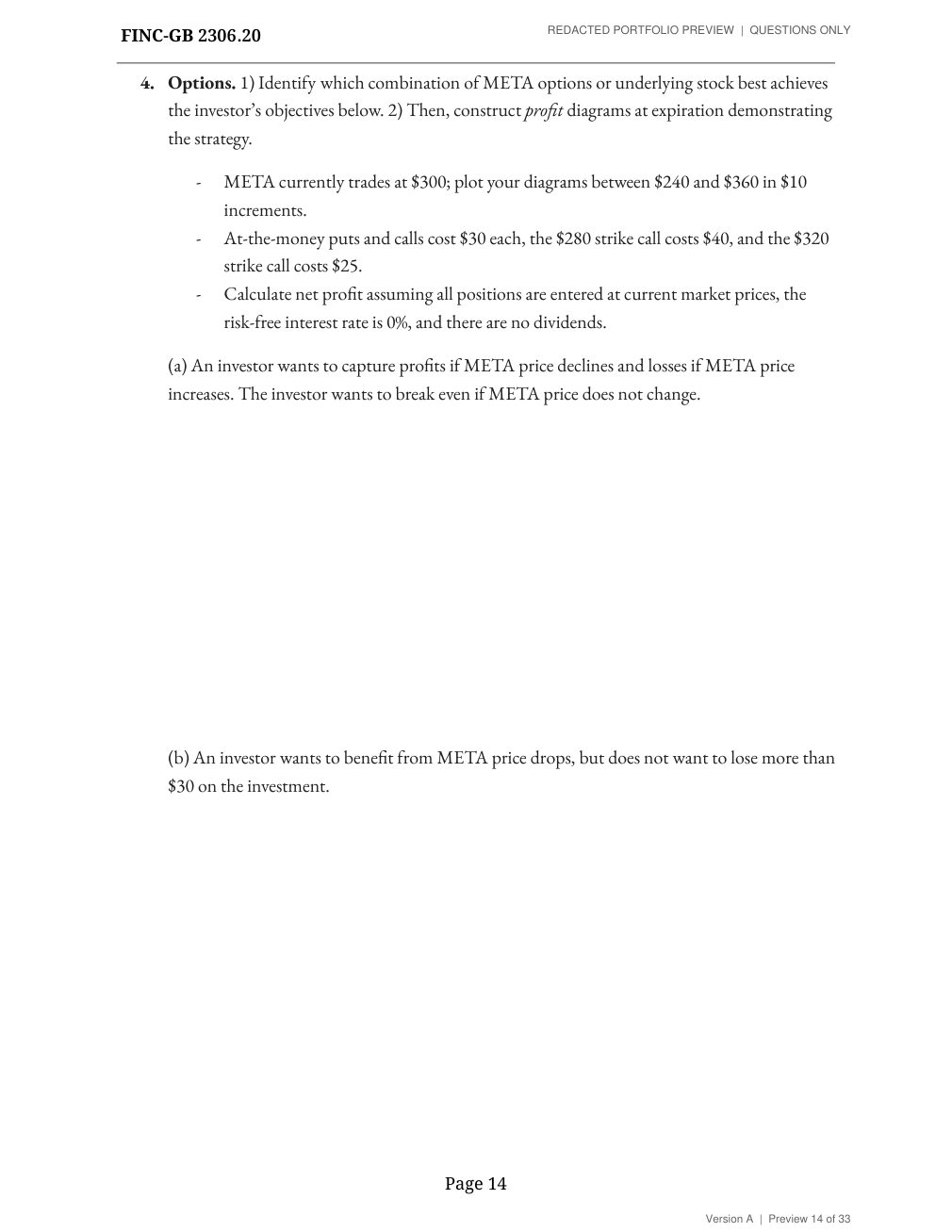
4. Options. 1) Identify which combination of META options or underlying stock best achieves
the investor’s objectives below. 2) Then, construct profit diagrams at expiration demonstrating
the strategy.
-
META currently trades at $300; plot your diagrams between $240 and $360 in $10
increments.
-
At-the-money puts and calls cost $30 each, the $280 strike call costs $40, and the $320
strike call costs $25.
-
Calculate net profit assuming all positions are entered at current market prices, the
risk-free interest rate is 0%, and there are no dividends.
(a) An investor wants to capture profits if META price declines and losses if META price
increases. The investor wants to break even if META price does not change.
(b) An investor wants to benefit from META price drops, but does not want to lose more than
$30 on the investment.
Page 14
REDACTED PORTFOLIO PREVIEW | QUESTIONS ONLY
Version A | Preview 14 of 33
FINC-GB 2306.20
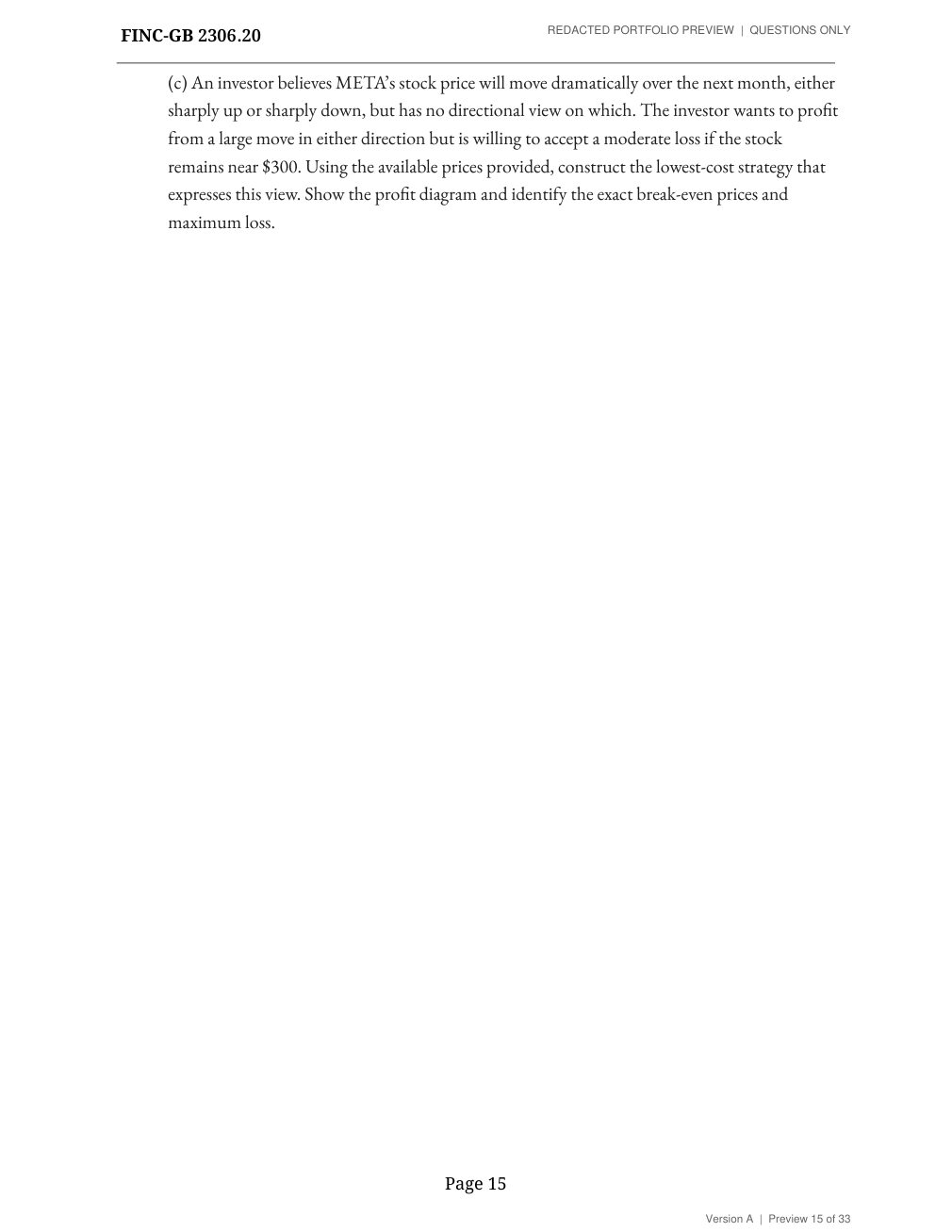
(c) An investor believes META’s stock price will move dramatically over the next month, either
sharply up or sharply down, but has no directional view on which. The investor wants to profit
from a large move in either direction but is willing to accept a moderate loss if the stock
remains near $300. Using the available prices provided, construct the lowest-cost strategy that
expresses this view. Show the profit diagram and identify the exact break-even prices and
maximum loss.
Page 15
REDACTED PORTFOLIO PREVIEW | QUESTIONS ONLY
Version A | Preview 15 of 33
FINC-GB 2306.20
5. Pick any disaster or crisis (financial or otherwise) and, in a few sentences for each, explain how
it was enabled by complexity, tight coupling, and human behavior. Bullet points are fine.
Page 16
REDACTED PORTFOLIO PREVIEW | QUESTIONS ONLY
Version A | Preview 16 of 33
Version B

Read text version
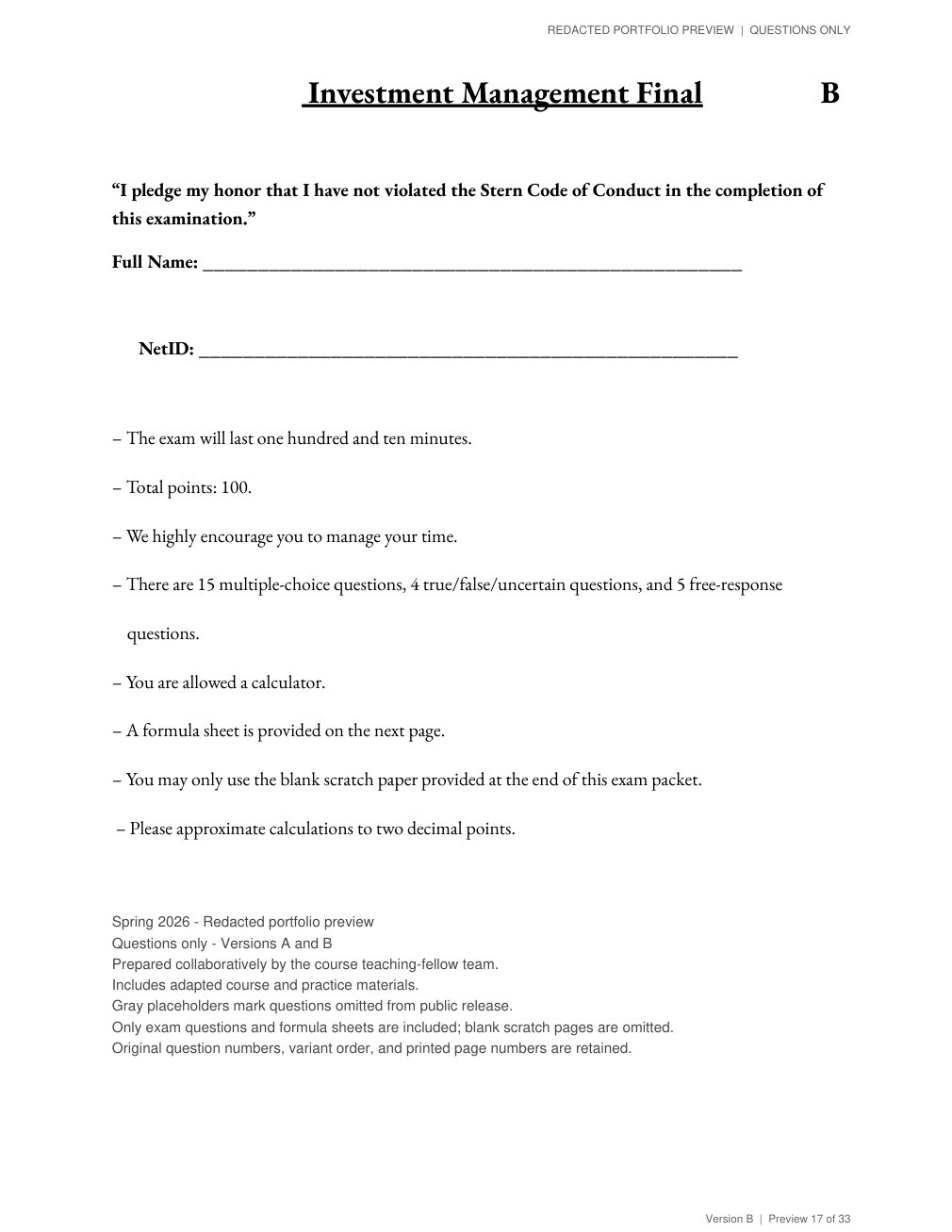
Investment Management Final B
“I pledge my honor that I have not violated the Stern Code of Conduct in the completion of
this examination.”
Full Name: _________________________________________________
NetID: _________________________________________________
– The exam will last one hundred and ten minutes.
– Total points: 100.
– We highly encourage you to manage your time.
– There are 15 multiple-choice questions, 4 true/false/uncertain questions, and 5 free-response
questions.
– You are allowed a calculator.
– A formula sheet is provided on the next page.
– You may only use the blank scratch paper provided at the end of this exam packet.
– Please approximate calculations to two decimal points.
Spring 2026 - Redacted portfolio preview
Questions only - Versions A and B
Prepared collaboratively by the course teaching-fellow team.
Includes adapted course and practice materials.
Gray placeholders mark questions omitted from public release.
Only exam questions and formula sheets are included; blank scratch pages are omitted.
Original question numbers, variant order, and printed page numbers are retained.
REDACTED PORTFOLIO PREVIEW | QUESTIONS ONLY
Version B | Preview 17 of 33
FINC-GB 2306.20
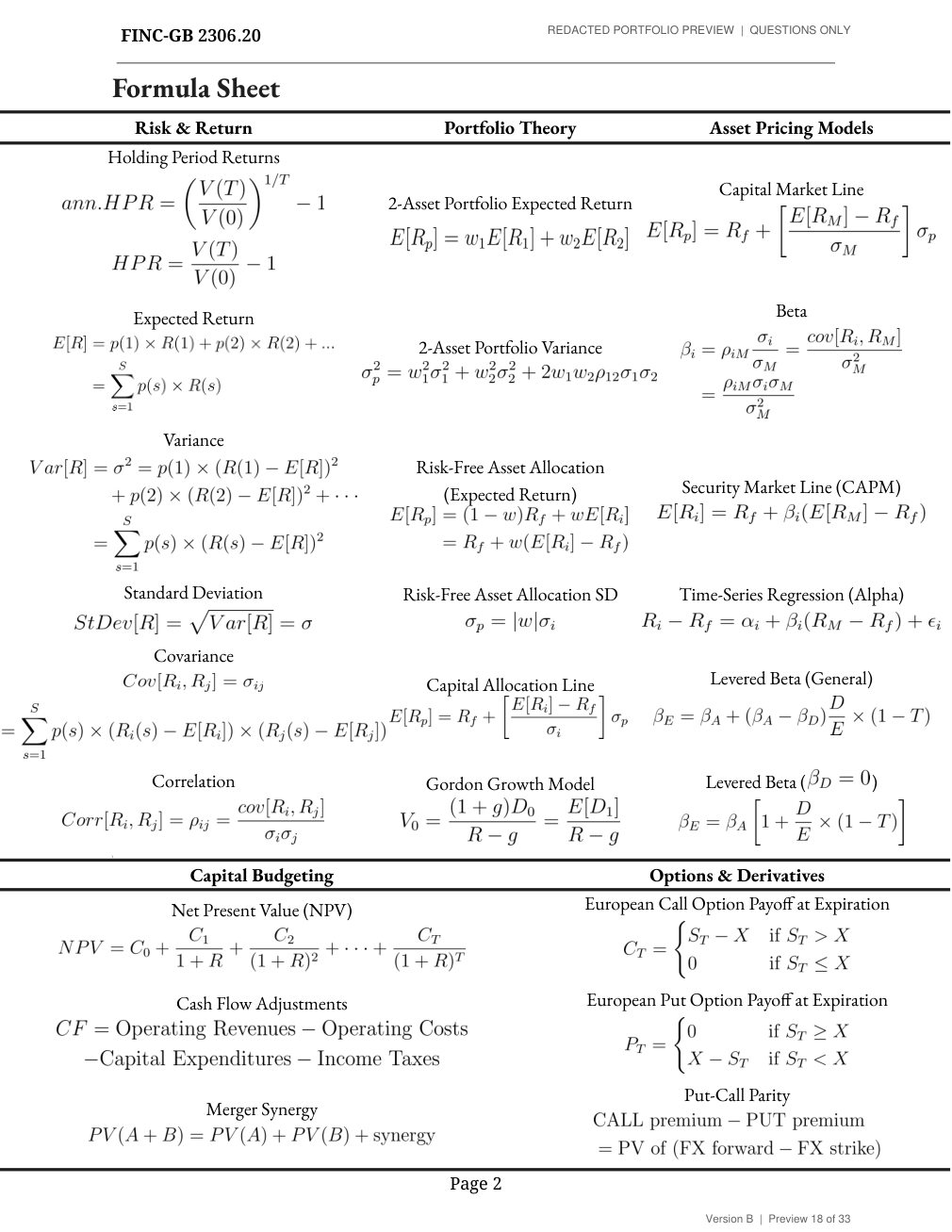
Formula Sheet
Risk & Return
Portfolio Theory
Asset Pricing Models
Holding Period Returns
2-Asset Portfolio Expected Return
Capital Market Line
Expected Return
2-Asset Portfolio Variance
Beta
Variance
Risk-Free Asset Allocation
(Expected Return)
Security Market Line (CAPM)
Standard Deviation
Risk-Free Asset Allocation SD
Time-Series Regression (Alpha)
Covariance
Capital Allocation Line
Levered Beta (General)
Correlation
Gordon Growth Model
Levered Beta (
)
\
Capital Budgeting
Options & Derivatives
Net Present Value (NPV)
European Call Option Payoff at Expiration
Cash Flow Adjustments
European Put Option Payoff at Expiration
Merger Synergy
Put-Call Parity
Page 2
REDACTED PORTFOLIO PREVIEW | QUESTIONS ONLY
Version B | Preview 18 of 33
FINC-GB 2306.20
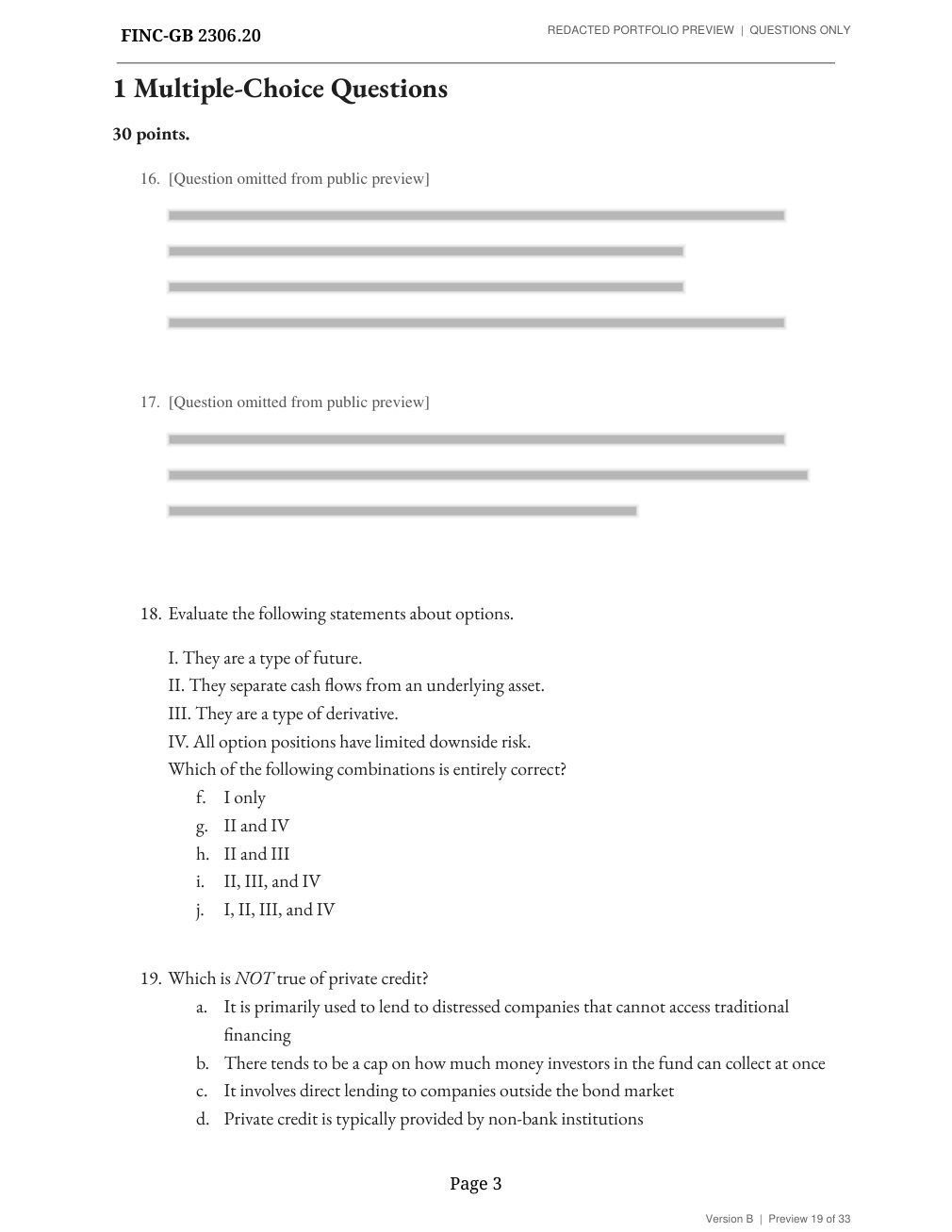
1 Multiple-Choice Questions
30 points.
18.Evaluate the following statements about options.
I. They are a type of future.
II. They separate cash flows from an underlying asset.
III. They are a type of derivative.
IV. All option positions have limited downside risk.
Which of the following combinations is entirely correct?
f. I only
g. II and IV
h. II and III
i.
II, III, and IV
j.
I, II, III, and IV
19.Which is NOT true of private credit?
a. It is primarily used to lend to distressed companies that cannot access traditional
financing
b. There tends to be a cap on how much money investors in the fund can collect at once
c. It involves direct lending to companies outside the bond market
d. Private credit is typically provided by non-bank institutions
Page 3
16. [Question omitted from public preview]
17. [Question omitted from public preview]
REDACTED PORTFOLIO PREVIEW | QUESTIONS ONLY
Version B | Preview 19 of 33
FINC-GB 2306.20
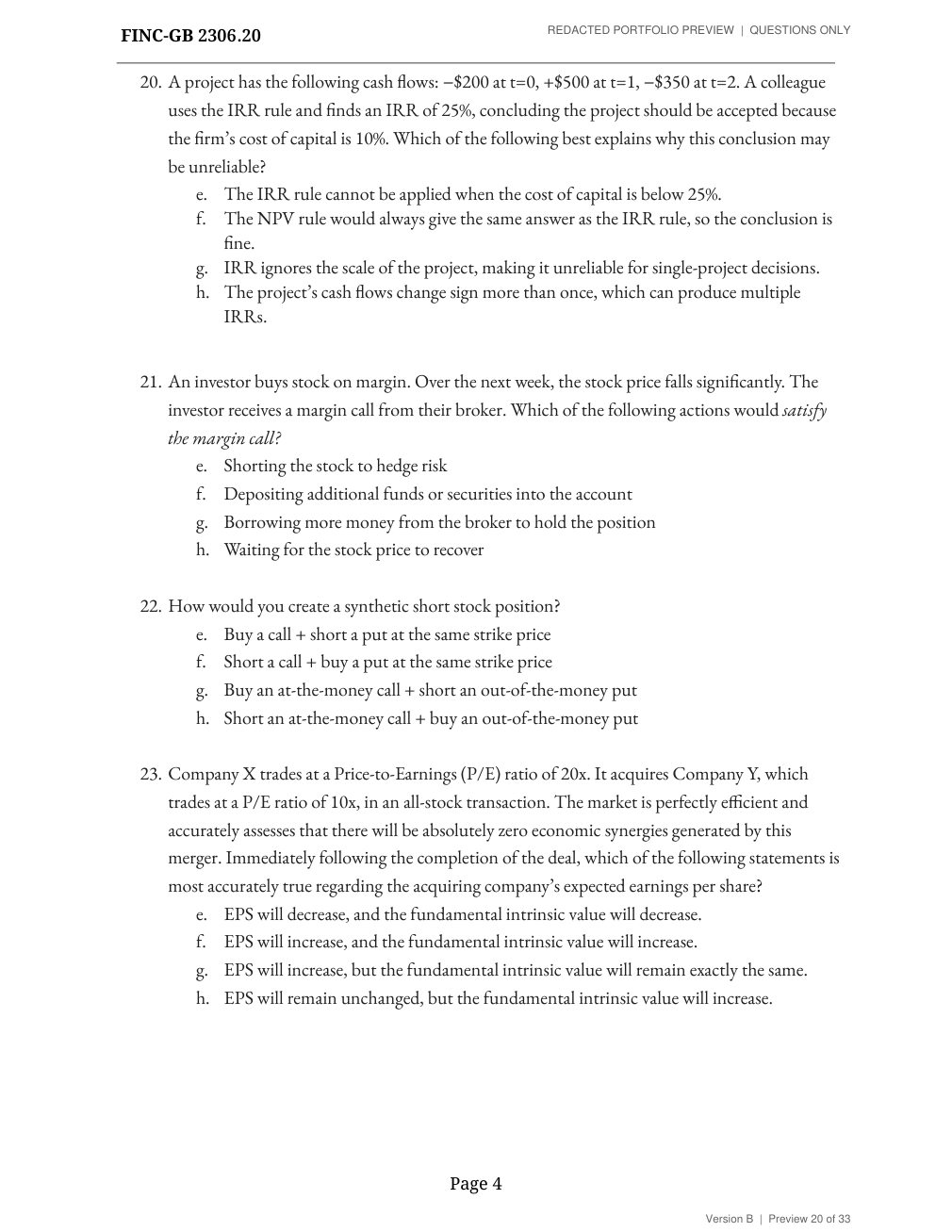
20.A project has the following cash flows: −$200 at t=0, +$500 at t=1, −$350 at t=2. A colleague
uses the IRR rule and finds an IRR of 25%, concluding the project should be accepted because
the firm’s cost of capital is 10%. Which of the following best explains why this conclusion may
be unreliable?
e. The IRR rule cannot be applied when the cost of capital is below 25%.
f. The NPV rule would always give the same answer as the IRR rule, so the conclusion is
fine.
g. IRR ignores the scale of the project, making it unreliable for single-project decisions.
h. The project’s cash flows change sign more than once, which can produce multiple
IRRs.
21.An investor buys stock on margin. Over the next week, the stock price falls significantly. The
investor receives a margin call from their broker. Which of the following actions would satisfy
the margin call?
e. Shorting the stock to hedge risk
f. Depositing additional funds or securities into the account
g. Borrowing more money from the broker to hold the position
h. Waiting for the stock price to recover
22.How would you create a synthetic short stock position?
e. Buy a call + short a put at the same strike price
f. Short a call + buy a put at the same strike price
g. Buy an at-the-money call + short an out-of-the-money put
h. Short an at-the-money call + buy an out-of-the-money put
23.Company X trades at a Price-to-Earnings (P/E) ratio of 20x. It acquires Company Y, which
trades at a P/E ratio of 10x, in an all-stock transaction. The market is perfectly efficient and
accurately assesses that there will be absolutely zero economic synergies generated by this
merger. Immediately following the completion of the deal, which of the following statements is
most accurately true regarding the acquiring company’s expected earnings per share?
e. EPS will decrease, and the fundamental intrinsic value will decrease.
f. EPS will increase, and the fundamental intrinsic value will increase.
g. EPS will increase, but the fundamental intrinsic value will remain exactly the same.
h. EPS will remain unchanged, but the fundamental intrinsic value will increase.
Page 4
REDACTED PORTFOLIO PREVIEW | QUESTIONS ONLY
Version B | Preview 20 of 33
FINC-GB 2306.20
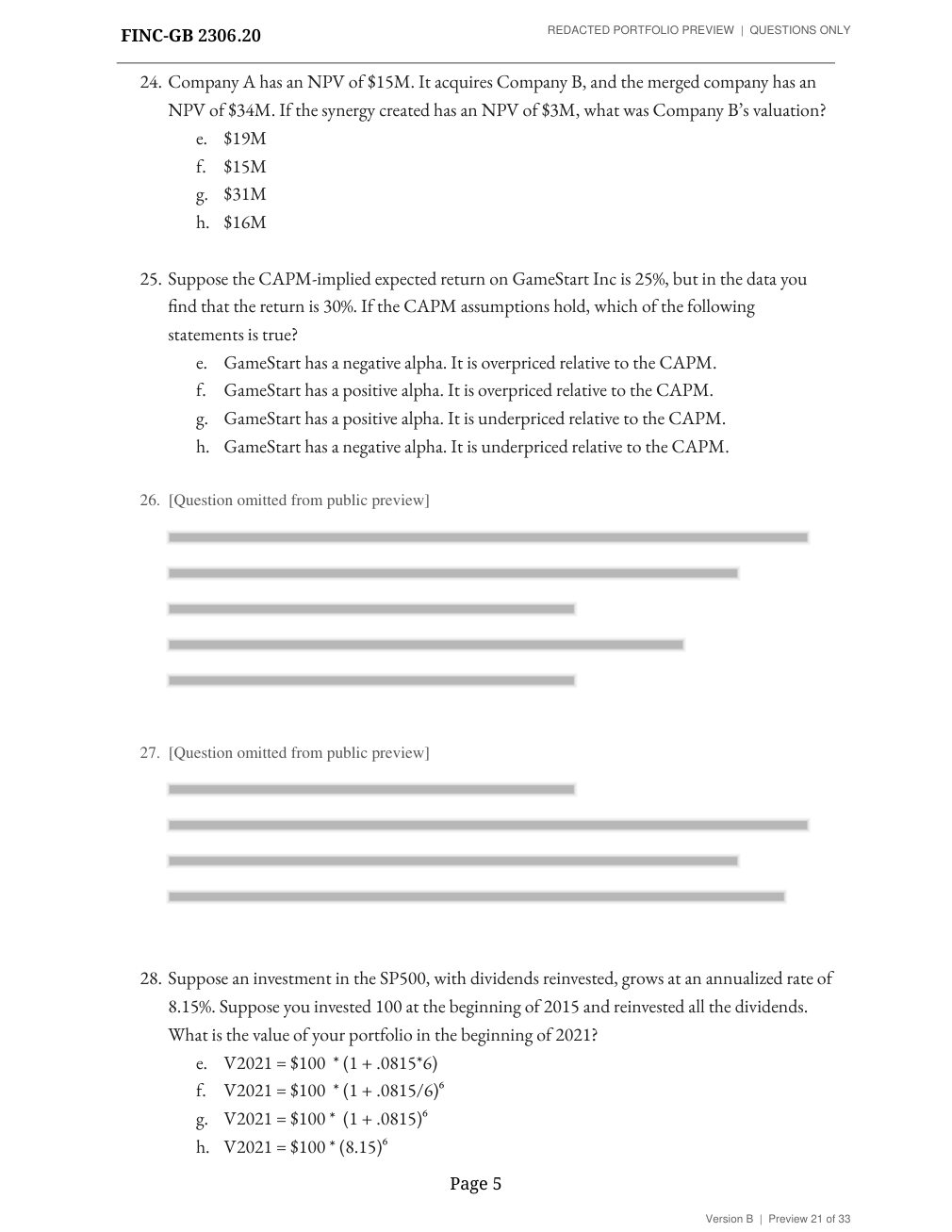
24.Company A has an NPV of $15M. It acquires Company B, and the merged company has an
NPV of $34M. If the synergy created has an NPV of $3M, what was Company B’s valuation?
e. $19M
f. $15M
g. $31M
h. $16M
25.Suppose the CAPM-implied expected return on GameStart Inc is 25%, but in the data you
find that the return is 30%. If the CAPM assumptions hold, which of the following
statements is true?
e. GameStart has a negative alpha. It is overpriced relative to the CAPM.
f. GameStart has a positive alpha. It is overpriced relative to the CAPM.
g. GameStart has a positive alpha. It is underpriced relative to the CAPM.
h. GameStart has a negative alpha. It is underpriced relative to the CAPM.
28.Suppose an investment in the SP500, with dividends reinvested, grows at an annualized rate of
8.15%. Suppose you invested 100 at the beginning of 2015 and reinvested all the dividends.
What is the value of your portfolio in the beginning of 2021?
e. V2021 = $100 * (1 + .0815*6)
f. V2021 = $100 * (1 + .0815/6)^6
g. V2021 = $100 * (1 + .0815)^6
h. V2021 = $100 * (8.15)^6
Page 5
26. [Question omitted from public preview]
27. [Question omitted from public preview]
REDACTED PORTFOLIO PREVIEW | QUESTIONS ONLY
Version B | Preview 21 of 33
FINC-GB 2306.20
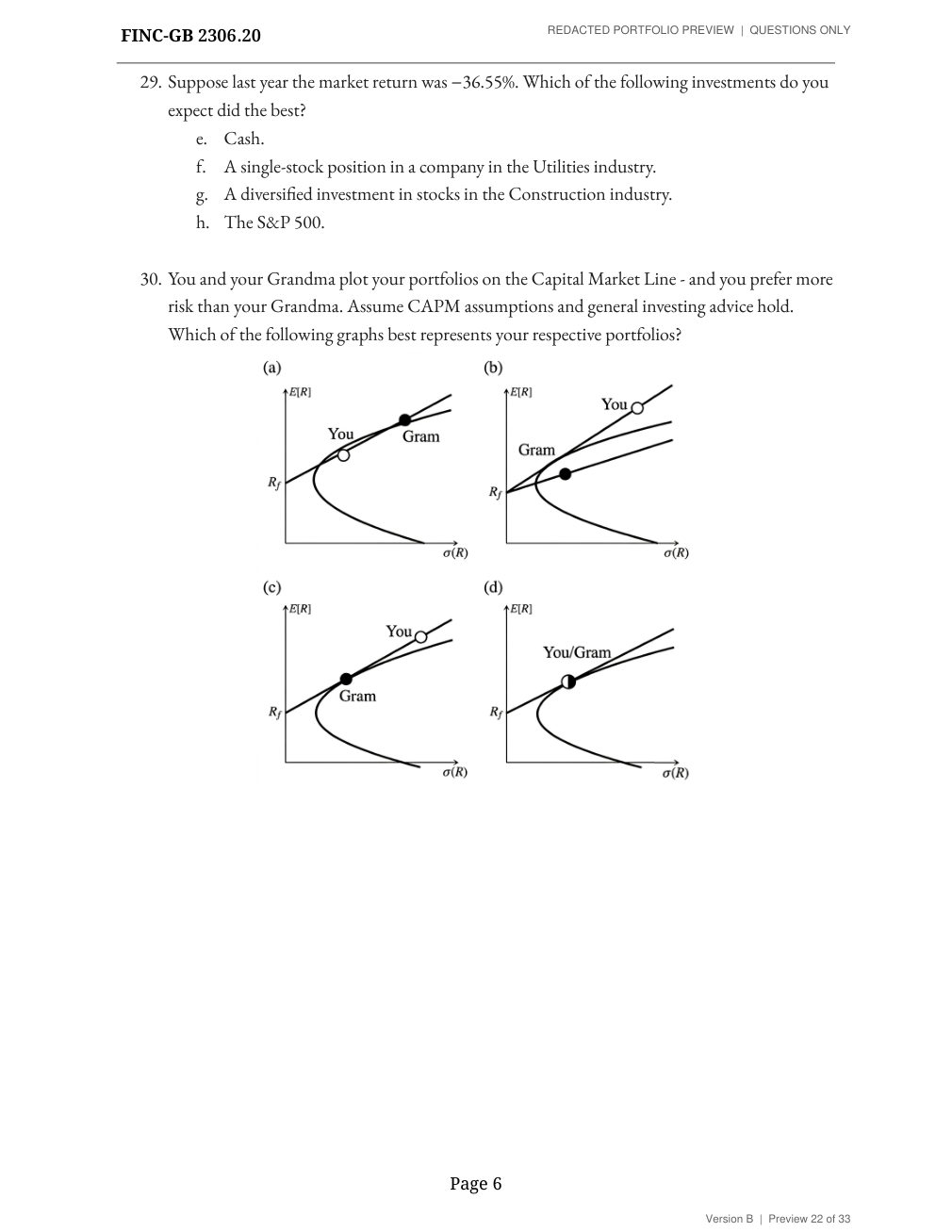
29.Suppose last year the market return was −36.55%. Which of the following investments do you
expect did the best?
e. Cash.
f. A single-stock position in a company in the Utilities industry.
g. A diversified investment in stocks in the Construction industry.
h. The S&P 500.
30.You and your Grandma plot your portfolios on the Capital Market Line - and you prefer more
risk than your Grandma. Assume CAPM assumptions and general investing advice hold.
Which of the following graphs best represents your respective portfolios?
Page 6
REDACTED PORTFOLIO PREVIEW | QUESTIONS ONLY
Version B | Preview 22 of 33
FINC-GB 2306.20
2 True/False/Uncertain
20 points. State True or False, and provide a clear written justification of 2–4 sentences. The
justification is required for full credit.
Page 7
5. [Question omitted from public preview]
REDACTED PORTFOLIO PREVIEW | QUESTIONS ONLY
Version B | Preview 23 of 33
FINC-GB 2306.20
Page 8
6. [Question omitted from public preview]
REDACTED PORTFOLIO PREVIEW | QUESTIONS ONLY
Version B | Preview 24 of 33
FINC-GB 2306.20
Page 9
7. [Question omitted from public preview]
REDACTED PORTFOLIO PREVIEW | QUESTIONS ONLY
Version B | Preview 25 of 33
FINC-GB 2306.20
Page 10
8. [Question omitted from public preview]
REDACTED PORTFOLIO PREVIEW | QUESTIONS ONLY
Version B | Preview 26 of 33
FINC-GB 2306.20
3 Free-Response Questions
50 points.
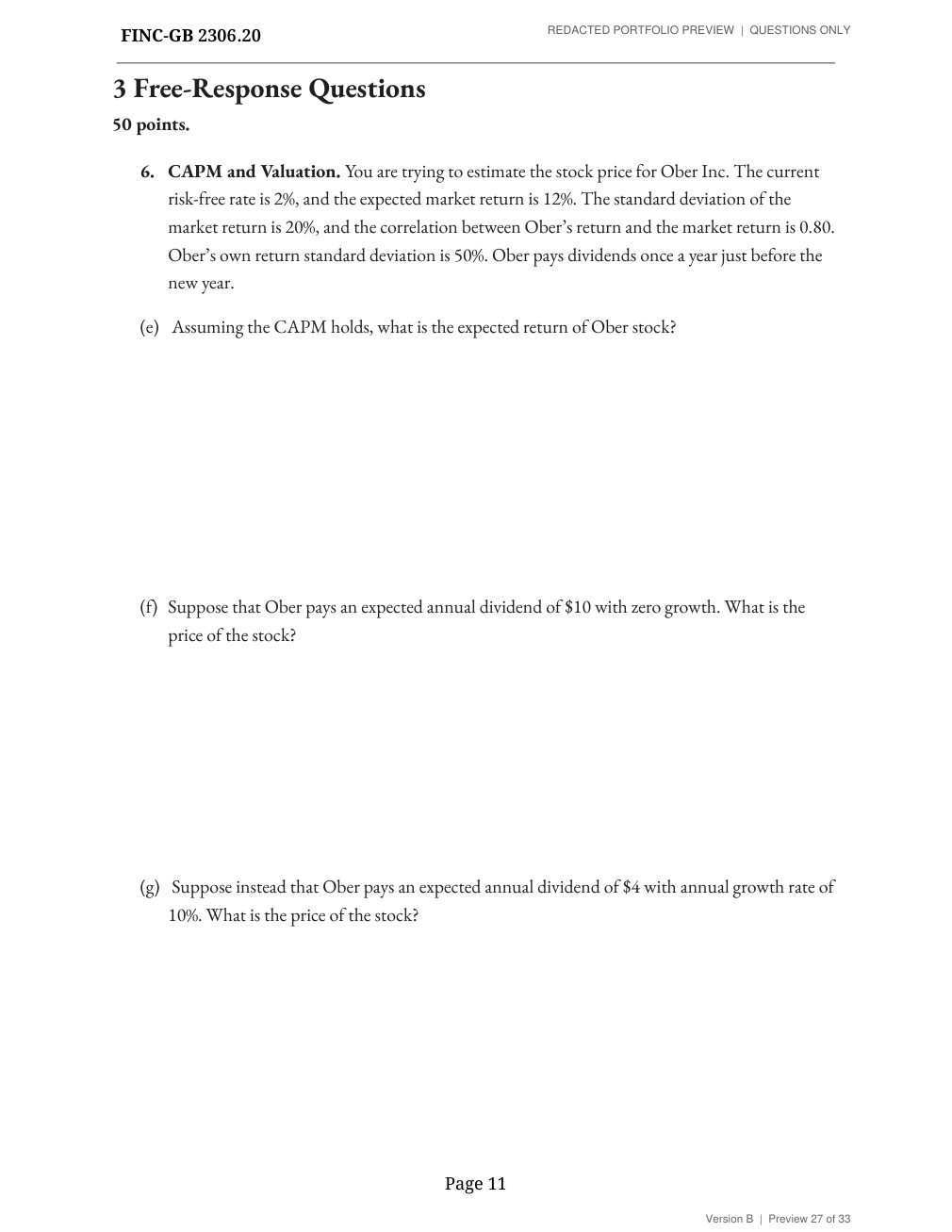
6. CAPM and Valuation. You are trying to estimate the stock price for Ober Inc. The current
risk-free rate is 2%, and the expected market return is 12%. The standard deviation of the
market return is 20%, and the correlation between Ober’s return and the market return is 0.80.
Ober’s own return standard deviation is 50%. Ober pays dividends once a year just before the
new year.
(e) Assuming the CAPM holds, what is the expected return of Ober stock?
(f) Suppose that Ober pays an expected annual dividend of $10 with zero growth. What is the
price of the stock?
(g) Suppose instead that Ober pays an expected annual dividend of $4 with annual growth rate of
10%. What is the price of the stock?
Page 11
REDACTED PORTFOLIO PREVIEW | QUESTIONS ONLY
Version B | Preview 27 of 33
FINC-GB 2306.20
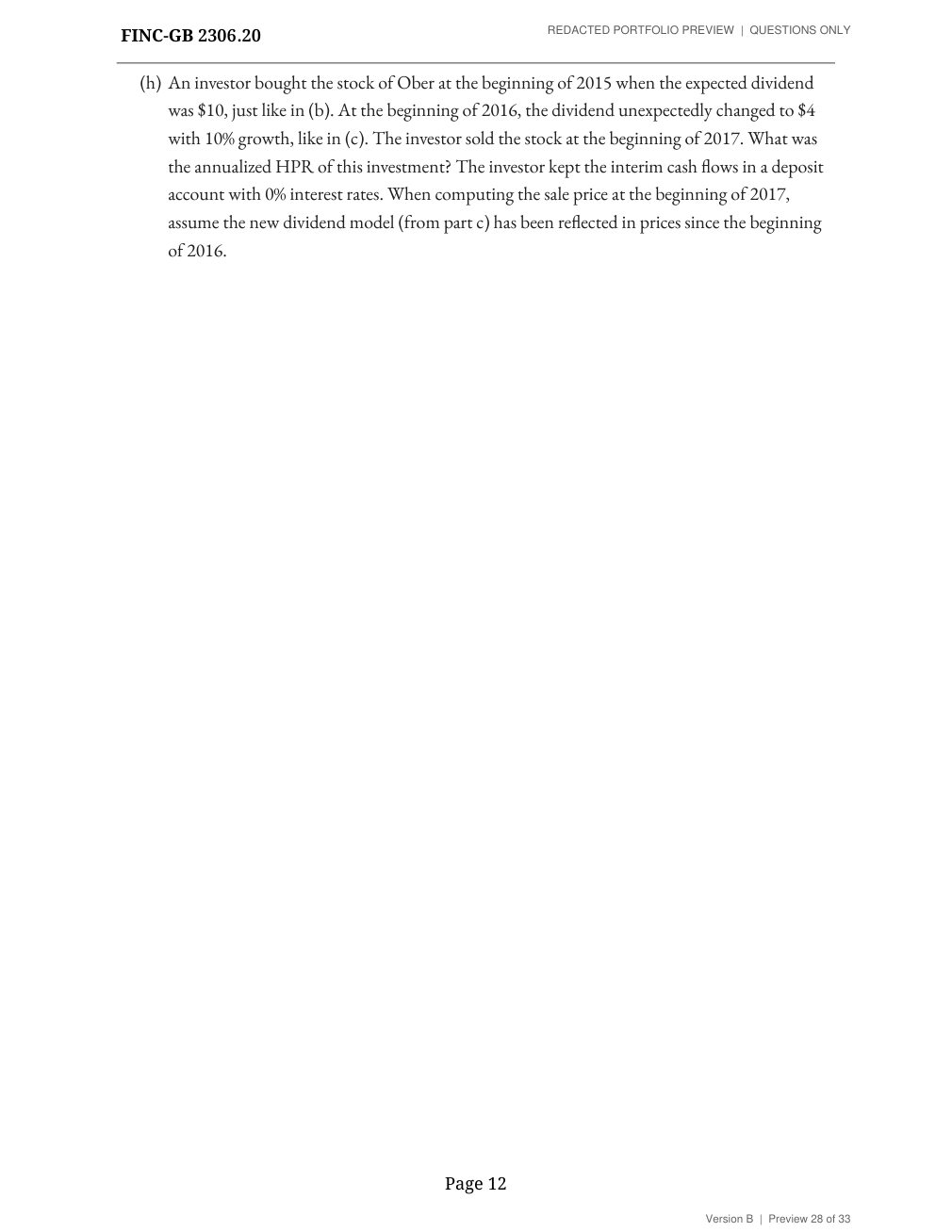
(h) An investor bought the stock of Ober at the beginning of 2015 when the expected dividend
was $10, just like in (b). At the beginning of 2016, the dividend unexpectedly changed to $4
with 10% growth, like in (c). The investor sold the stock at the beginning of 2017. What was
the annualized HPR of this investment? The investor kept the interim cash flows in a deposit
account with 0% interest rates. When computing the sale price at the beginning of 2017,
assume the new dividend model (from part c) has been reflected in prices since the beginning
of 2016.
Page 12
REDACTED PORTFOLIO PREVIEW | QUESTIONS ONLY
Version B | Preview 28 of 33
FINC-GB 2306.20
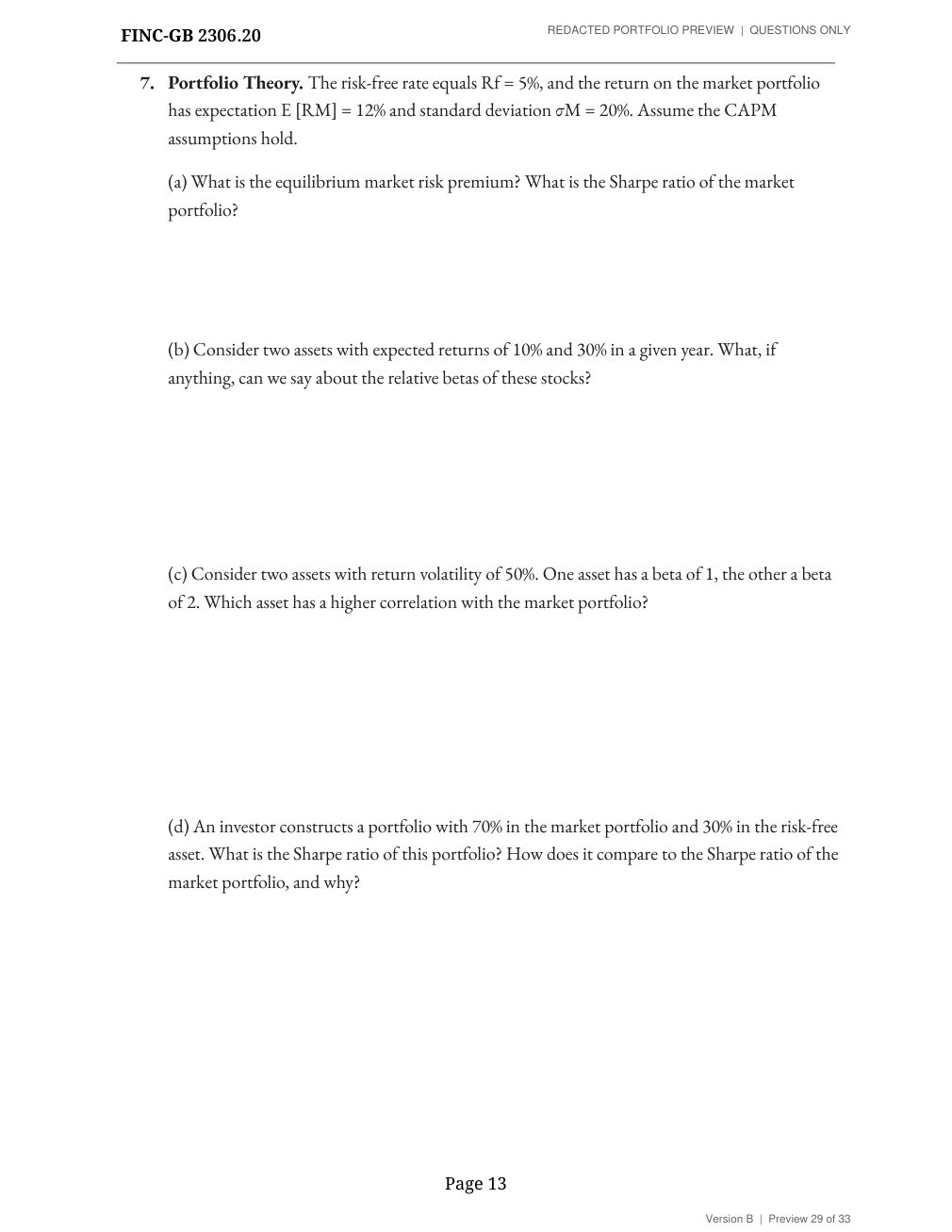
7. Portfolio Theory. The risk-free rate equals Rf = 5%, and the return on the market portfolio
has expectation E [RM] = 12% and standard deviation σM = 20%. Assume the CAPM
assumptions hold.
(a) What is the equilibrium market risk premium? What is the Sharpe ratio of the market
portfolio?
(b) Consider two assets with expected returns of 10% and 30% in a given year. What, if
anything, can we say about the relative betas of these stocks?
(c) Consider two assets with return volatility of 50%. One asset has a beta of 1, the other a beta
of 2. Which asset has a higher correlation with the market portfolio?
(d) An investor constructs a portfolio with 70% in the market portfolio and 30% in the risk-free
asset. What is the Sharpe ratio of this portfolio? How does it compare to the Sharpe ratio of the
market portfolio, and why?
Page 13
REDACTED PORTFOLIO PREVIEW | QUESTIONS ONLY
Version B | Preview 29 of 33
FINC-GB 2306.20
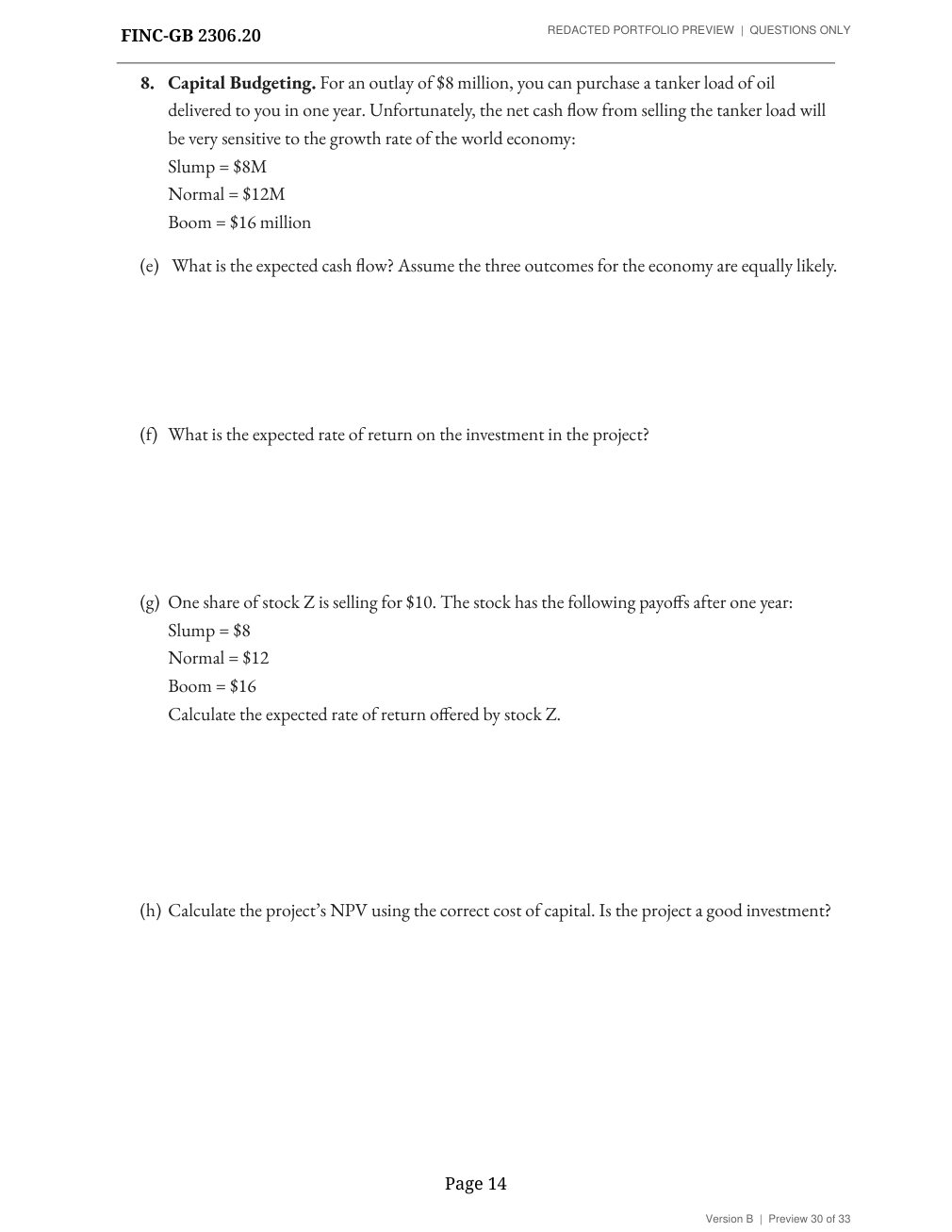
8. Capital Budgeting. For an outlay of $8 million, you can purchase a tanker load of oil
delivered to you in one year. Unfortunately, the net cash flow from selling the tanker load will
be very sensitive to the growth rate of the world economy:
Slump = $8M
Normal = $12M
Boom = $16 million
(e) What is the expected cash flow? Assume the three outcomes for the economy are equally likely.
(f) What is the expected rate of return on the investment in the project?
(g) One share of stock Z is selling for $10. The stock has the following payoffs after one year:
Slump = $8
Normal = $12
Boom = $16
Calculate the expected rate of return offered by stock Z.
(h) Calculate the project’s NPV using the correct cost of capital. Is the project a good investment?
Page 14
REDACTED PORTFOLIO PREVIEW | QUESTIONS ONLY
Version B | Preview 30 of 33
FINC-GB 2306.20
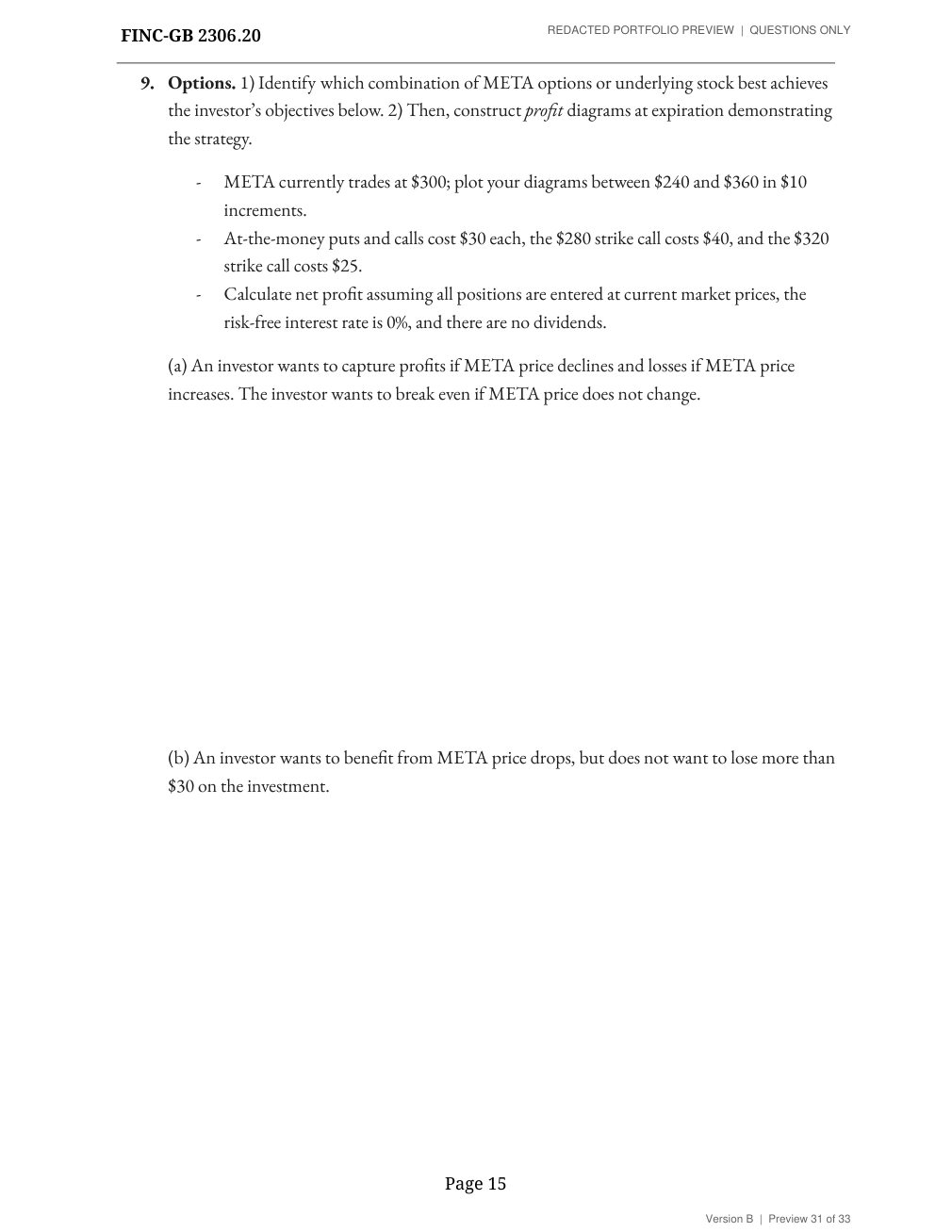
9. Options. 1) Identify which combination of META options or underlying stock best achieves
the investor’s objectives below. 2) Then, construct profit diagrams at expiration demonstrating
the strategy.
-
META currently trades at $300; plot your diagrams between $240 and $360 in $10
increments.
-
At-the-money puts and calls cost $30 each, the $280 strike call costs $40, and the $320
strike call costs $25.
-
Calculate net profit assuming all positions are entered at current market prices, the
risk-free interest rate is 0%, and there are no dividends.
(a) An investor wants to capture profits if META price declines and losses if META price
increases. The investor wants to break even if META price does not change.
(b) An investor wants to benefit from META price drops, but does not want to lose more than
$30 on the investment.
Page 15
REDACTED PORTFOLIO PREVIEW | QUESTIONS ONLY
Version B | Preview 31 of 33
FINC-GB 2306.20
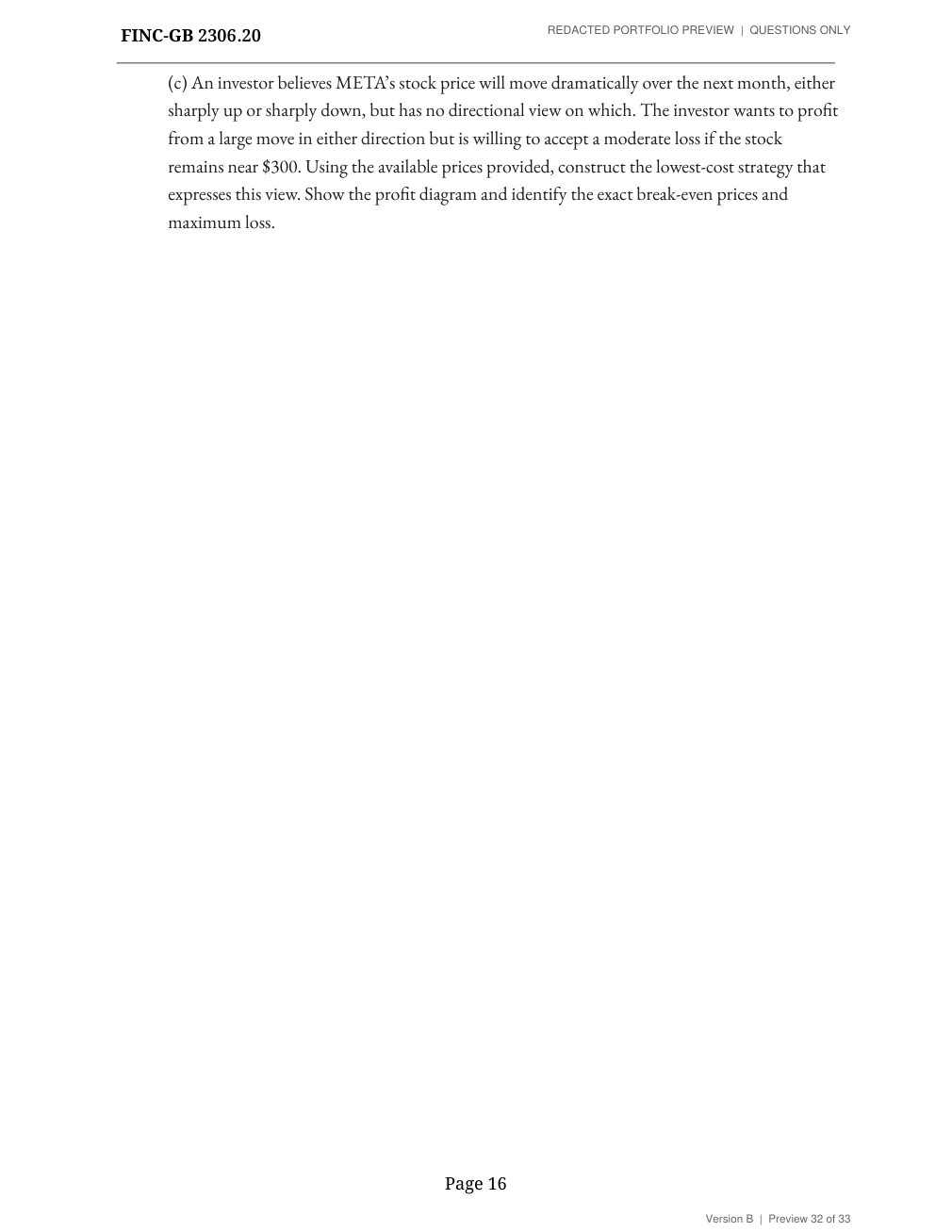
(c) An investor believes META’s stock price will move dramatically over the next month, either
sharply up or sharply down, but has no directional view on which. The investor wants to profit
from a large move in either direction but is willing to accept a moderate loss if the stock
remains near $300. Using the available prices provided, construct the lowest-cost strategy that
expresses this view. Show the profit diagram and identify the exact break-even prices and
maximum loss.
Page 16
REDACTED PORTFOLIO PREVIEW | QUESTIONS ONLY
Version B | Preview 32 of 33
FINC-GB 2306.20
10.Pick any disaster or crisis (financial or otherwise) and, in a few sentences for each, explain how
it was enabled by complexity, tight coupling, and human behavior. Bullet points are fine.
Page 17
REDACTED PORTFOLIO PREVIEW | QUESTIONS ONLY
Version B | Preview 33 of 33