
Quinn Dyer.
NYU Stern Student
“Poor is the mind that always uses the inventions of others, and invents nothing itself.”
Hieronymus Bosch — quote source, opens in a new tab
I’m Quinn, an undergraduate at NYU Stern. I’m interested in finance, economics, psychology, and building things.
Find me here, or send me an email.
Links will be added here.
Investment Management — Midterm
May 2026 · I helped write this exam with Professor Philip Vasan ↗ and the teaching team.
These previews show questions only. Answer keys and other restricted material are left out; obscured blocks mark the omissions.
Version A

Read text version
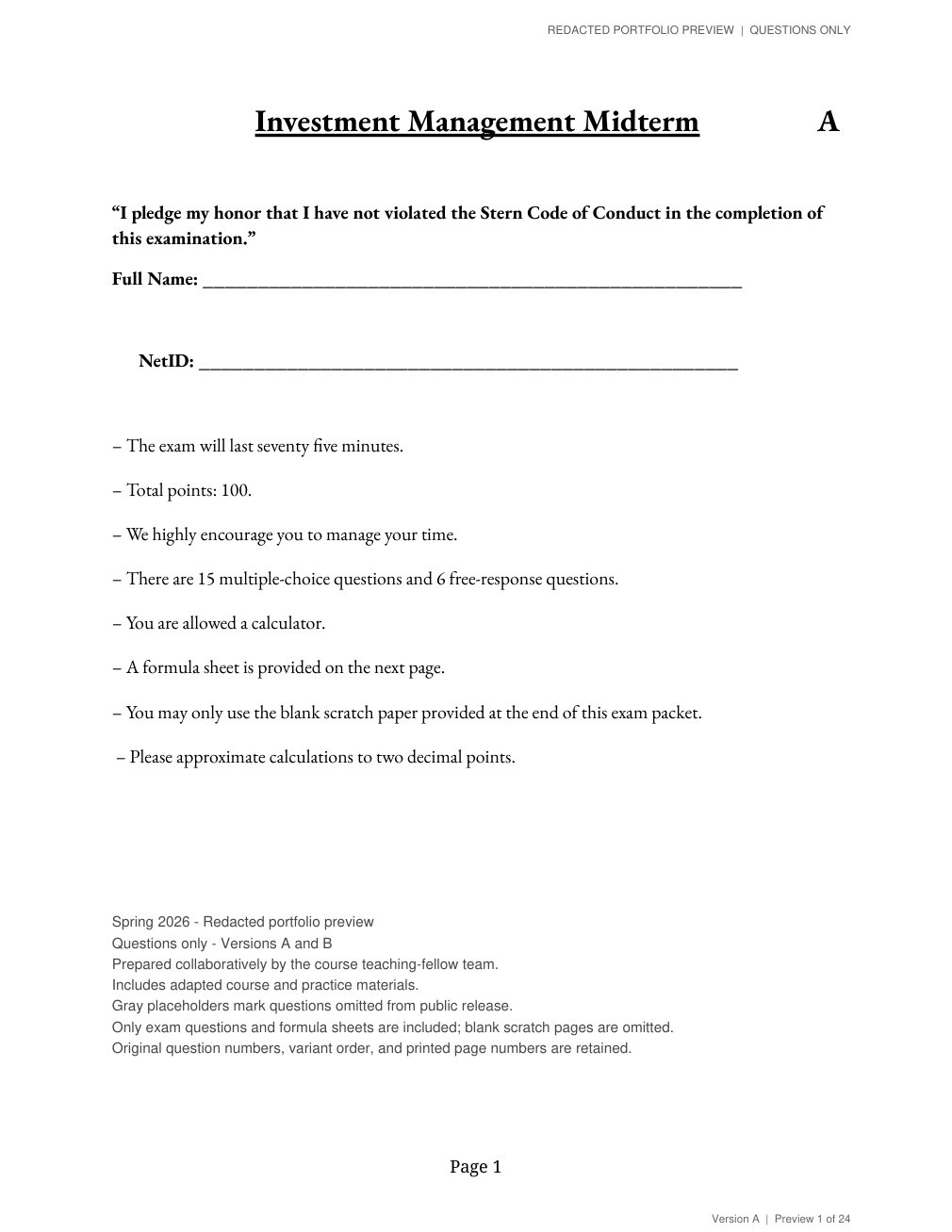
Investment Management Midterm A
“I pledge my honor that I have not violated the Stern Code of Conduct in the completion of
this examination.”
Full Name: _________________________________________________
NetID: _________________________________________________
– The exam will last seventy five minutes.
– Total points: 100.
– We highly encourage you to manage your time.
– There are 15 multiple-choice questions and 6 free-response questions.
– You are allowed a calculator.
– A formula sheet is provided on the next page.
– You may only use the blank scratch paper provided at the end of this exam packet.
– Please approximate calculations to two decimal points.
Page 1
Spring 2026 - Redacted portfolio preview
Questions only - Versions A and B
Prepared collaboratively by the course teaching-fellow team.
Includes adapted course and practice materials.
Gray placeholders mark questions omitted from public release.
Only exam questions and formula sheets are included; blank scratch pages are omitted.
Original question numbers, variant order, and printed page numbers are retained.
REDACTED PORTFOLIO PREVIEW | QUESTIONS ONLY
Version A | Preview 1 of 24
FINC-GB 2306.20
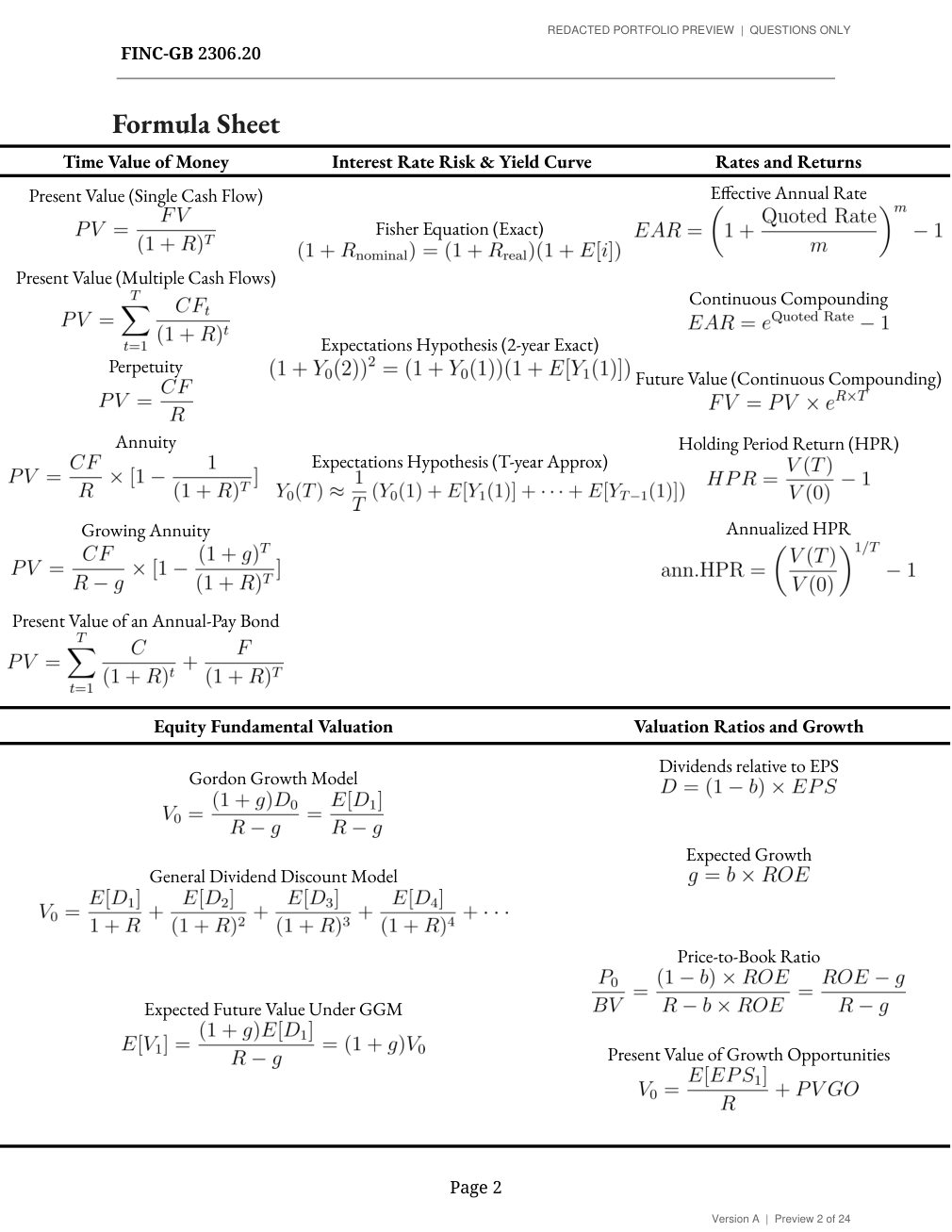
Formula Sheet
Time Value of Money
Interest Rate Risk & Yield Curve
Rates and Returns
Present Value (Single Cash Flow)
Fisher Equation (Exact)
Effective Annual Rate
Present Value (Multiple Cash Flows)
Expectations Hypothesis (2-year Exact)
Continuous Compounding
Perpetuity
Future Value (Continuous Compounding)
Annuity
Expectations Hypothesis (T-year Approx)
Holding Period Return (HPR)
Growing Annuity
Annualized HPR
Present Value of an Annual-Pay Bond
Equity Fundamental Valuation
Valuation Ratios and Growth
Gordon Growth Model
Dividends relative to EPS
General Dividend Discount Model
Expected Growth
Expected Future Value Under GGM
Price-to-Book Ratio
Present Value of Growth Opportunities
Page 2
REDACTED PORTFOLIO PREVIEW | QUESTIONS ONLY
Version A | Preview 2 of 24
FINC-GB 2306.20
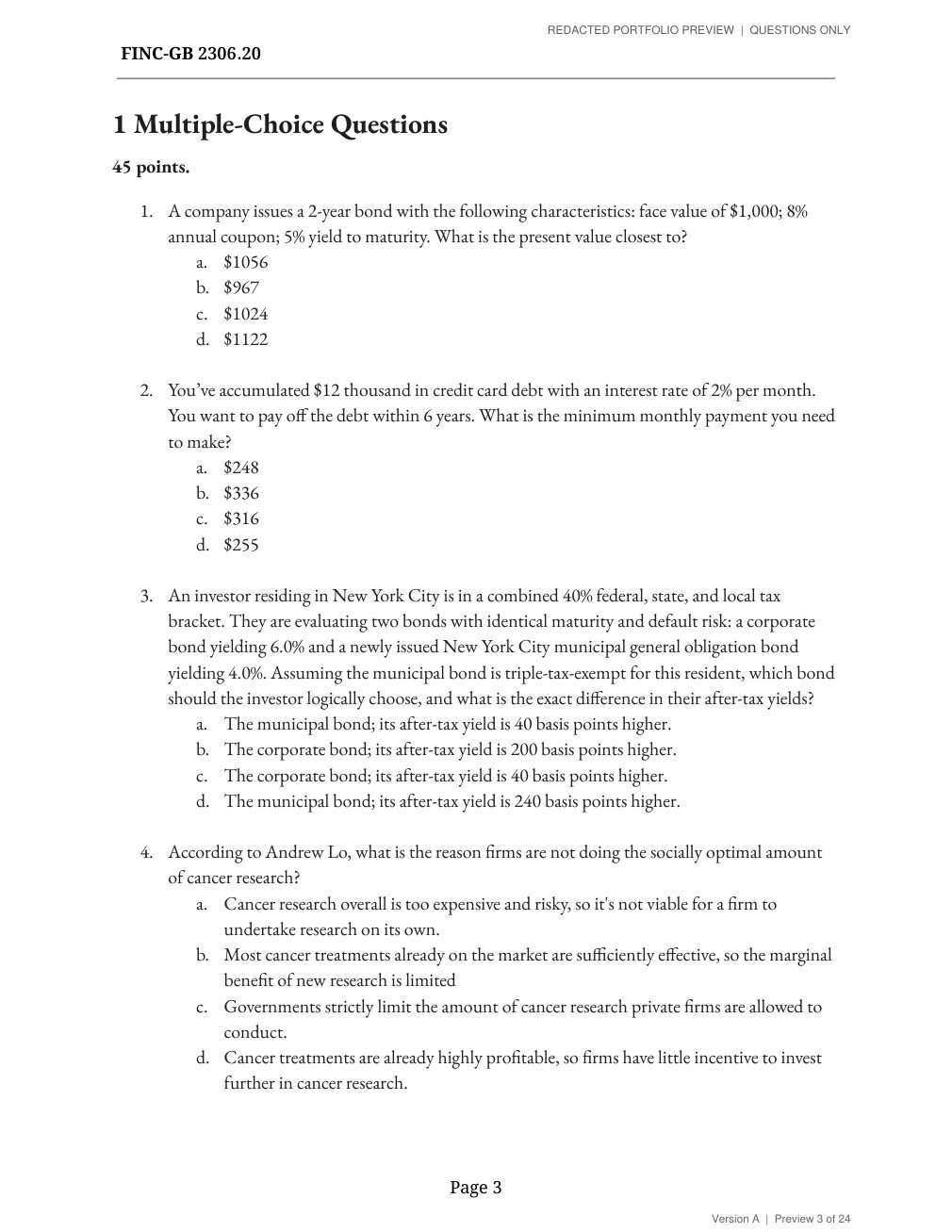
1 Multiple-Choice Questions
45 points.
1. A company issues a 2-year bond with the following characteristics: face value of $1,000; 8%
annual coupon; 5% yield to maturity. What is the present value closest to?
a. $1056
b. $967
c. $1024
d. $1122
2. You’ve accumulated $12 thousand in credit card debt with an interest rate of 2% per month.
You want to pay off the debt within 6 years. What is the minimum monthly payment you need
to make?
a. $248
b. $336
c. $316
d. $255
3. An investor residing in New York City is in a combined 40% federal, state, and local tax
bracket. They are evaluating two bonds with identical maturity and default risk: a corporate
bond yielding 6.0% and a newly issued New York City municipal general obligation bond
yielding 4.0%. Assuming the municipal bond is triple-tax-exempt for this resident, which bond
should the investor logically choose, and what is the exact difference in their after-tax yields?
a. The municipal bond; its after-tax yield is 40 basis points higher.
b. The corporate bond; its after-tax yield is 200 basis points higher.
c. The corporate bond; its after-tax yield is 40 basis points higher.
d. The municipal bond; its after-tax yield is 240 basis points higher.
4. According to Andrew Lo, what is the reason firms are not doing the socially optimal amount
of cancer research?
a. Cancer research overall is too expensive and risky, so it's not viable for a firm to
undertake research on its own.
b. Most cancer treatments already on the market are sufficiently effective, so the marginal
benefit of new research is limited
c. Governments strictly limit the amount of cancer research private firms are allowed to
conduct.
d. Cancer treatments are already highly profitable, so firms have little incentive to invest
further in cancer research.
Page 3
REDACTED PORTFOLIO PREVIEW | QUESTIONS ONLY
Version A | Preview 3 of 24
FINC-GB 2306.20
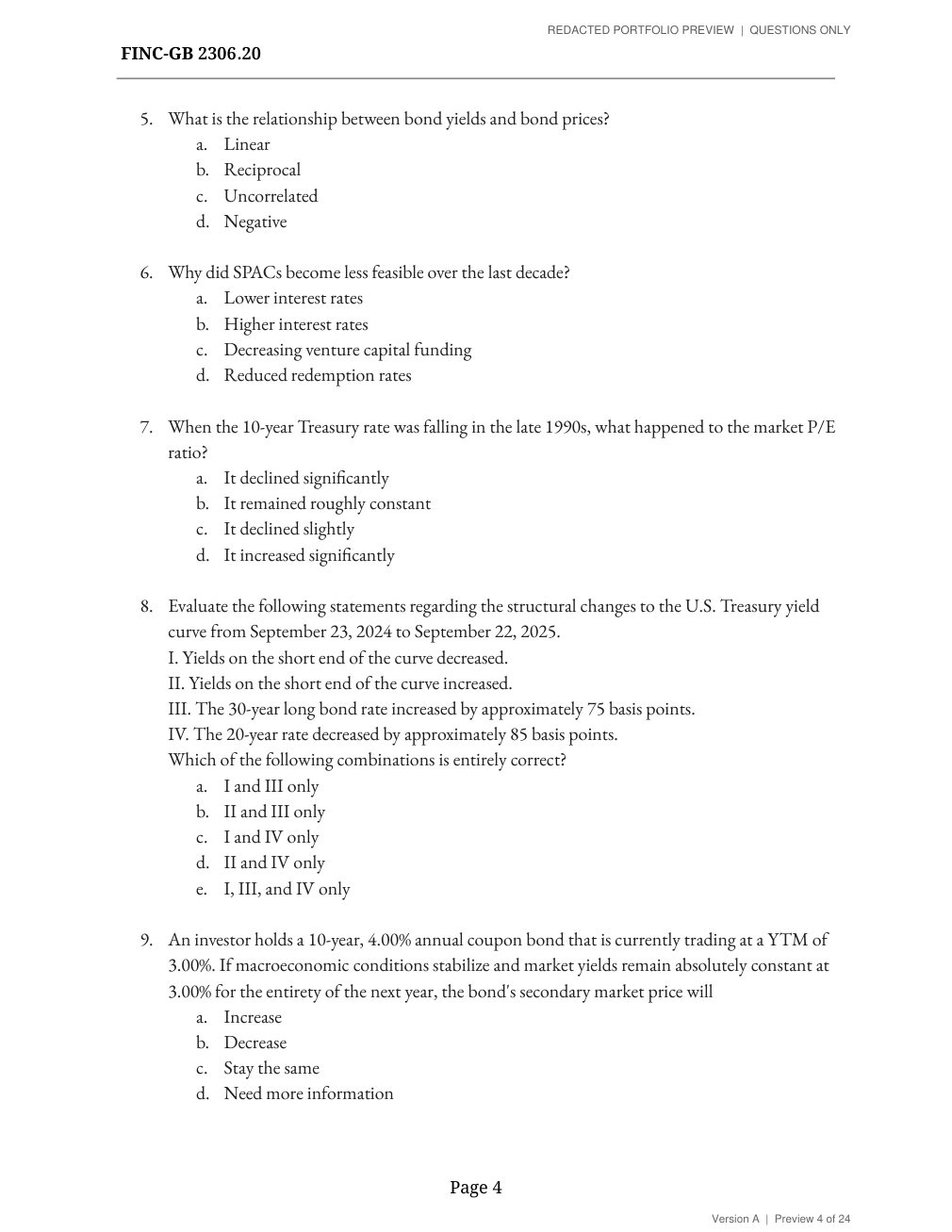
5. What is the relationship between bond yields and bond prices?
a. Linear
b. Reciprocal
c. Uncorrelated
d. Negative
6. Why did SPACs become less feasible over the last decade?
a. Lower interest rates
b. Higher interest rates
c. Decreasing venture capital funding
d. Reduced redemption rates
7. When the 10-year Treasury rate was falling in the late 1990s, what happened to the market P/E
ratio?
a. It declined significantly
b. It remained roughly constant
c. It declined slightly
d. It increased significantly
8. Evaluate the following statements regarding the structural changes to the U.S. Treasury yield
curve from September 23, 2024 to September 22, 2025.
I. Yields on the short end of the curve decreased.
II. Yields on the short end of the curve increased.
III. The 30-year long bond rate increased by approximately 75 basis points.
IV. The 20-year rate decreased by approximately 85 basis points.
Which of the following combinations is entirely correct?
a. I and III only
b. II and III only
c. I and IV only
d. II and IV only
e. I, III, and IV only
9. An investor holds a 10-year, 4.00% annual coupon bond that is currently trading at a YTM of
3.00%. If macroeconomic conditions stabilize and market yields remain absolutely constant at
3.00% for the entirety of the next year, the bond's secondary market price will
a. Increase
b. Decrease
c. Stay the same
d. Need more information
Page 4
REDACTED PORTFOLIO PREVIEW | QUESTIONS ONLY
Version A | Preview 4 of 24
FINC-GB 2306.20
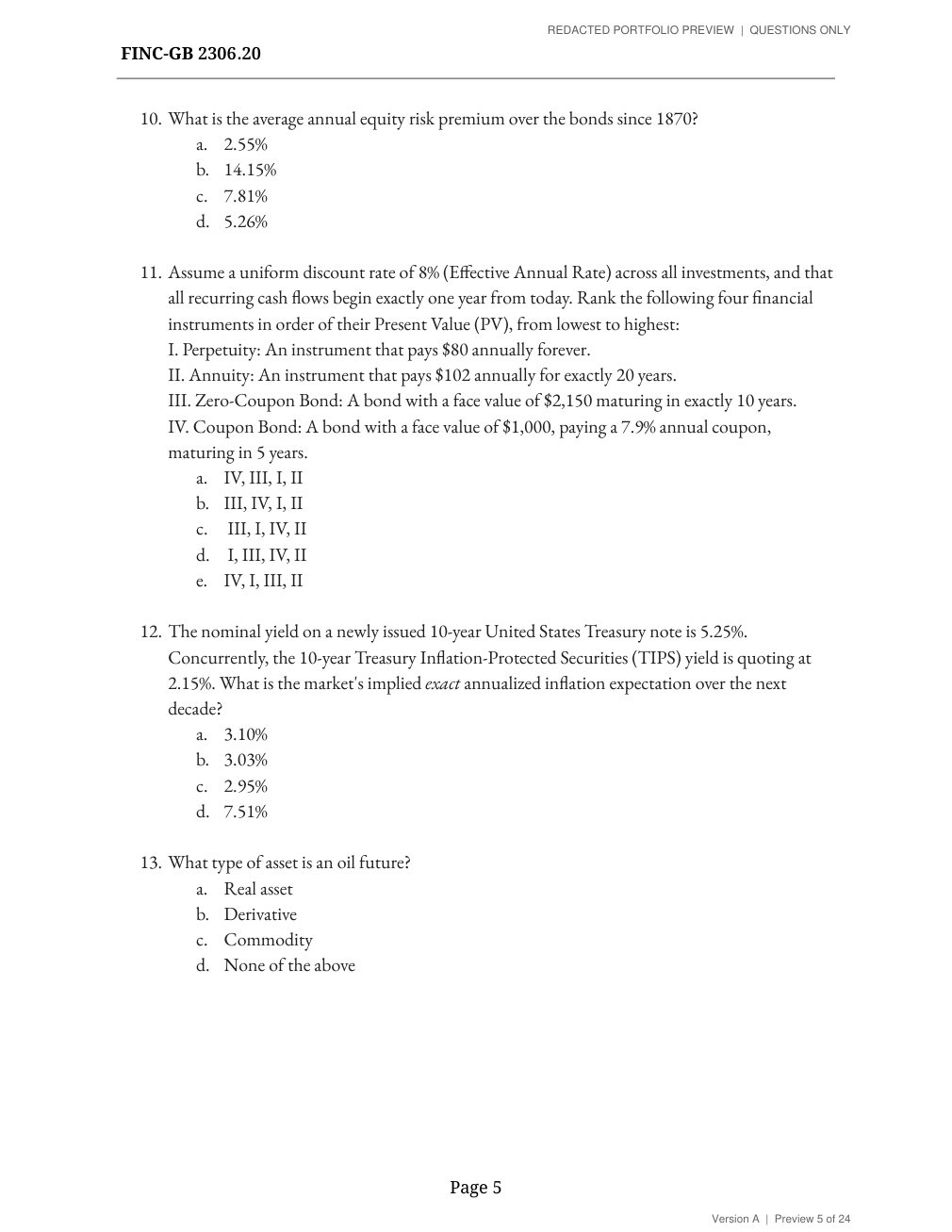
10.What is the average annual equity risk premium over the bonds since 1870?
a. 2.55%
b. 14.15%
c. 7.81%
d. 5.26%
11.Assume a uniform discount rate of 8% (Effective Annual Rate) across all investments, and that
all recurring cash flows begin exactly one year from today. Rank the following four financial
instruments in order of their Present Value (PV), from lowest to highest:
I. Perpetuity: An instrument that pays $80 annually forever.
II. Annuity: An instrument that pays $102 annually for exactly 20 years.
III. Zero-Coupon Bond: A bond with a face value of $2,150 maturing in exactly 10 years.
IV. Coupon Bond: A bond with a face value of $1,000, paying a 7.9% annual coupon,
maturing in 5 years.
a. IV, III, I, II
b. III, IV, I, II
c. III, I, IV, II
d. I, III, IV, II
e. IV, I, III, II
12.The nominal yield on a newly issued 10-year United States Treasury note is 5.25%.
Concurrently, the 10-year Treasury Inflation-Protected Securities (TIPS) yield is quoting at
2.15%. What is the market's implied exact annualized inflation expectation over the next
decade?
a. 3.10%
b. 3.03%
c. 2.95%
d. 7.51%
13.What type of asset is an oil future?
a. Real asset
b. Derivative
c. Commodity
d. None of the above
Page 5
REDACTED PORTFOLIO PREVIEW | QUESTIONS ONLY
Version A | Preview 5 of 24
FINC-GB 2306.20
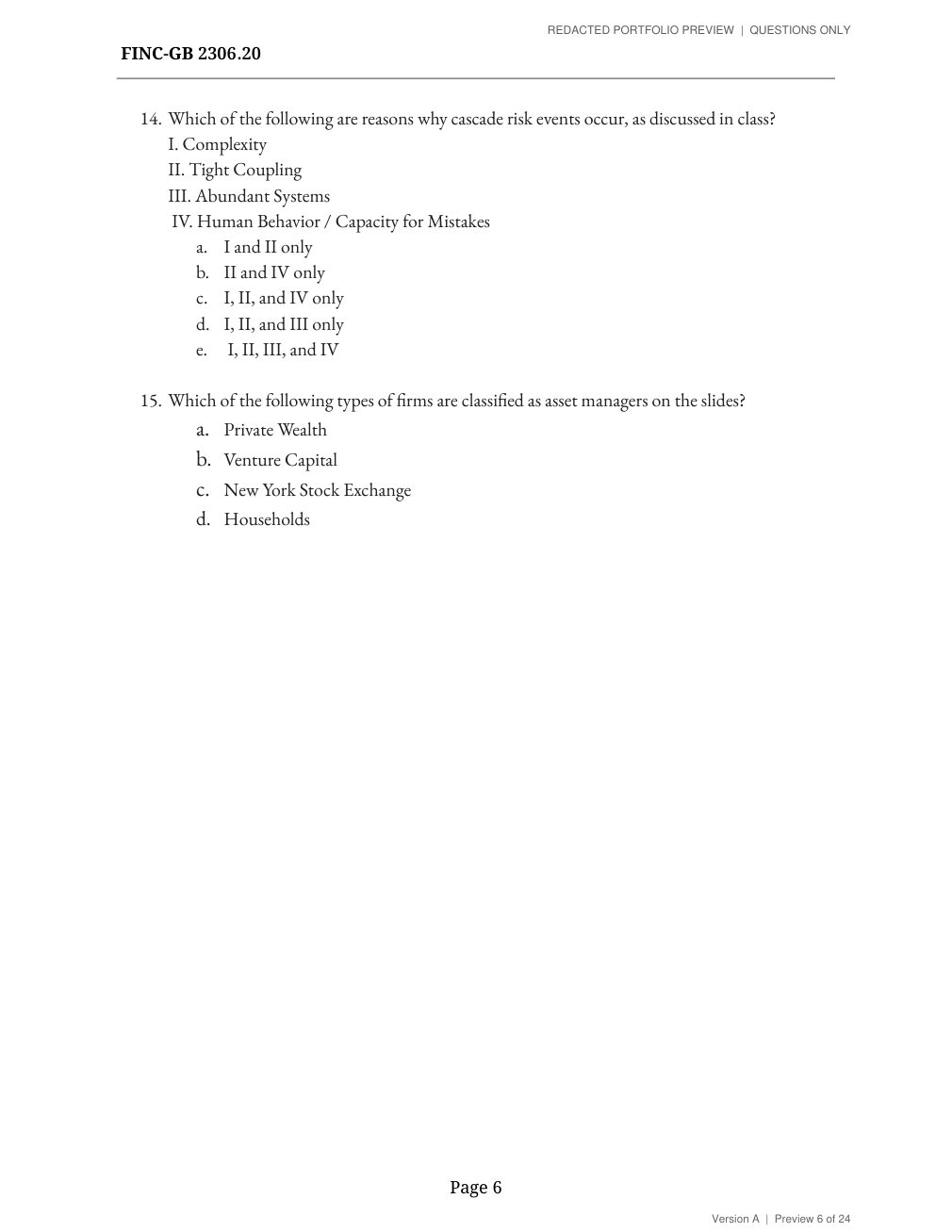
14.Which of the following are reasons why cascade risk events occur, as discussed in class?
I. Complexity
II. Tight Coupling
III. Abundant Systems
IV. Human Behavior / Capacity for Mistakes
a. I and II only
b. II and IV only
c. I, II, and IV only
d. I, II, and III only
e. I, II, III, and IV
15.Which of the following types of firms are classified as asset managers on the slides?
a. Private Wealth
b. Venture Capital
c. New York Stock Exchange
d. Households
Page 6
REDACTED PORTFOLIO PREVIEW | QUESTIONS ONLY
Version A | Preview 6 of 24
FINC-GB 2306.20
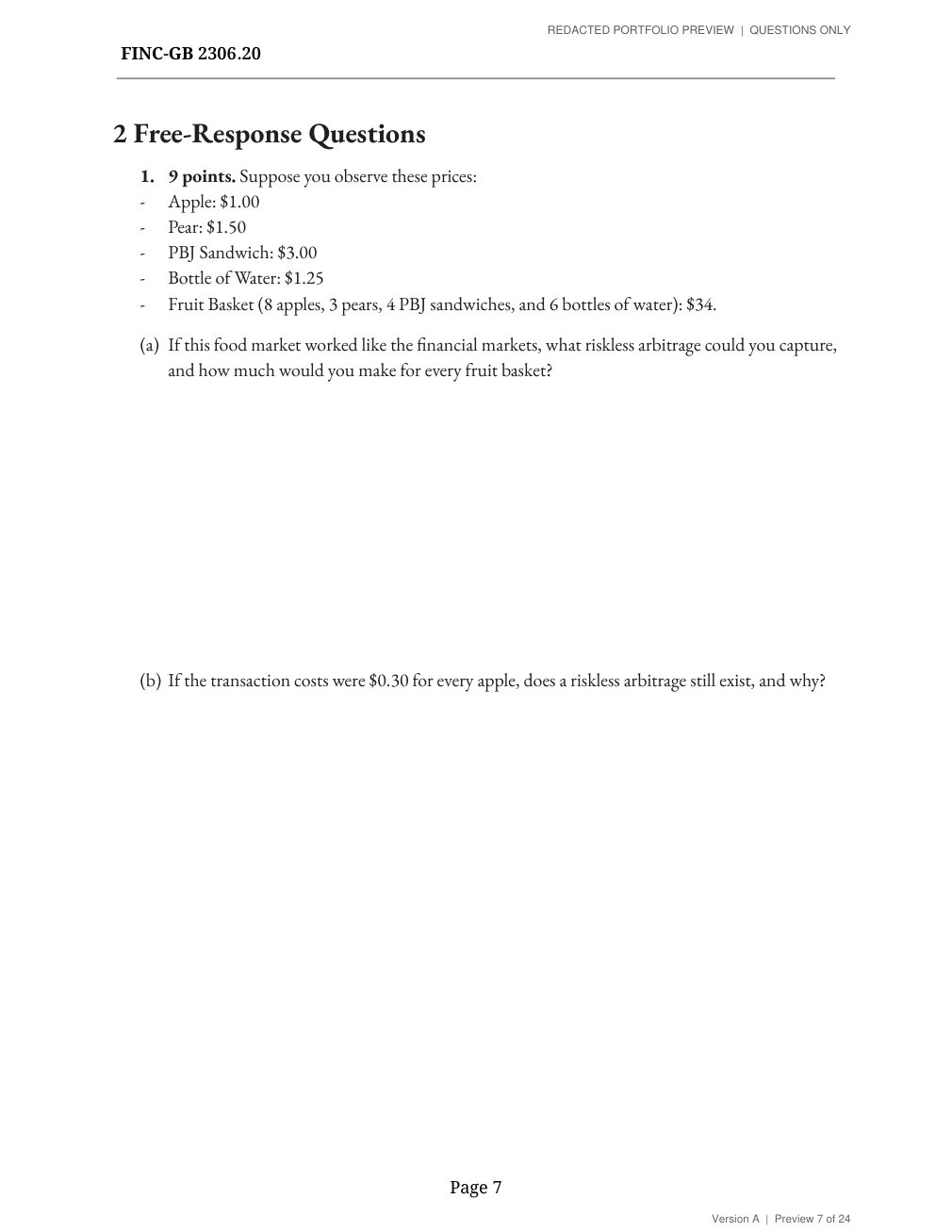
2 Free-Response Questions
1. 9 points. Suppose you observe these prices:
-
Apple: $1.00
-
Pear: $1.50
-
PBJ Sandwich: $3.00
-
Bottle of Water: $1.25
-
Fruit Basket (8 apples, 3 pears, 4 PBJ sandwiches, and 6 bottles of water): $34.
(a) If this food market worked like the financial markets, what riskless arbitrage could you capture,
and how much would you make for every fruit basket?
(b) If the transaction costs were $0.30 for every apple, does a riskless arbitrage still exist, and why?
Page 7
REDACTED PORTFOLIO PREVIEW | QUESTIONS ONLY
Version A | Preview 7 of 24
FINC-GB 2306.20
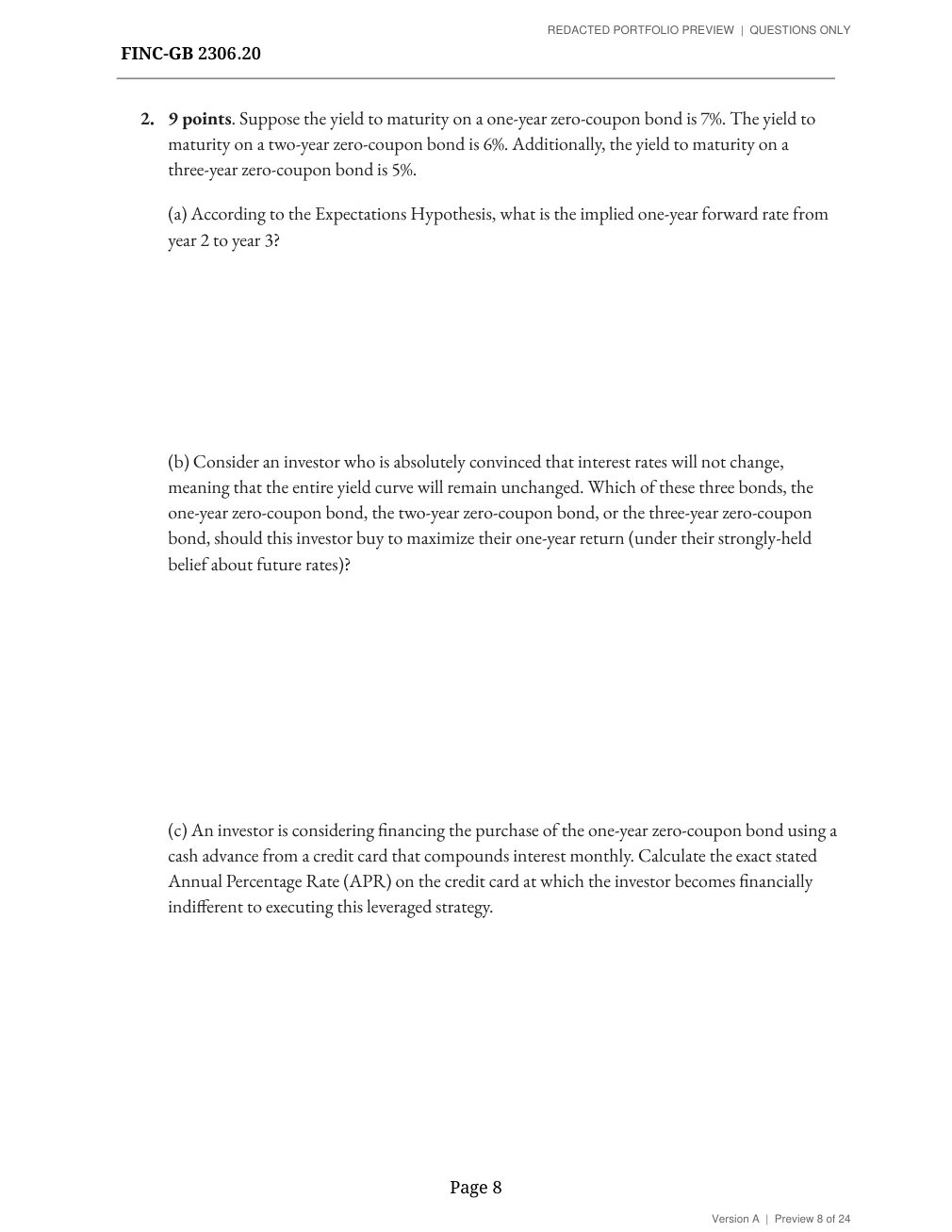
2. 9 points. Suppose the yield to maturity on a one-year zero-coupon bond is 7%. The yield to
maturity on a two-year zero-coupon bond is 6%. Additionally, the yield to maturity on a
three-year zero-coupon bond is 5%.
(a) According to the Expectations Hypothesis, what is the implied one-year forward rate from
year 2 to year 3?
(b) Consider an investor who is absolutely convinced that interest rates will not change,
meaning that the entire yield curve will remain unchanged. Which of these three bonds, the
one-year zero-coupon bond, the two-year zero-coupon bond, or the three-year zero-coupon
bond, should this investor buy to maximize their one-year return (under their strongly-held
belief about future rates)?
(c) An investor is considering financing the purchase of the one-year zero-coupon bond using a
cash advance from a credit card that compounds interest monthly. Calculate the exact stated
Annual Percentage Rate (APR) on the credit card at which the investor becomes financially
indifferent to executing this leveraged strategy.
Page 8
REDACTED PORTFOLIO PREVIEW | QUESTIONS ONLY
Version A | Preview 8 of 24
FINC-GB 2306.20
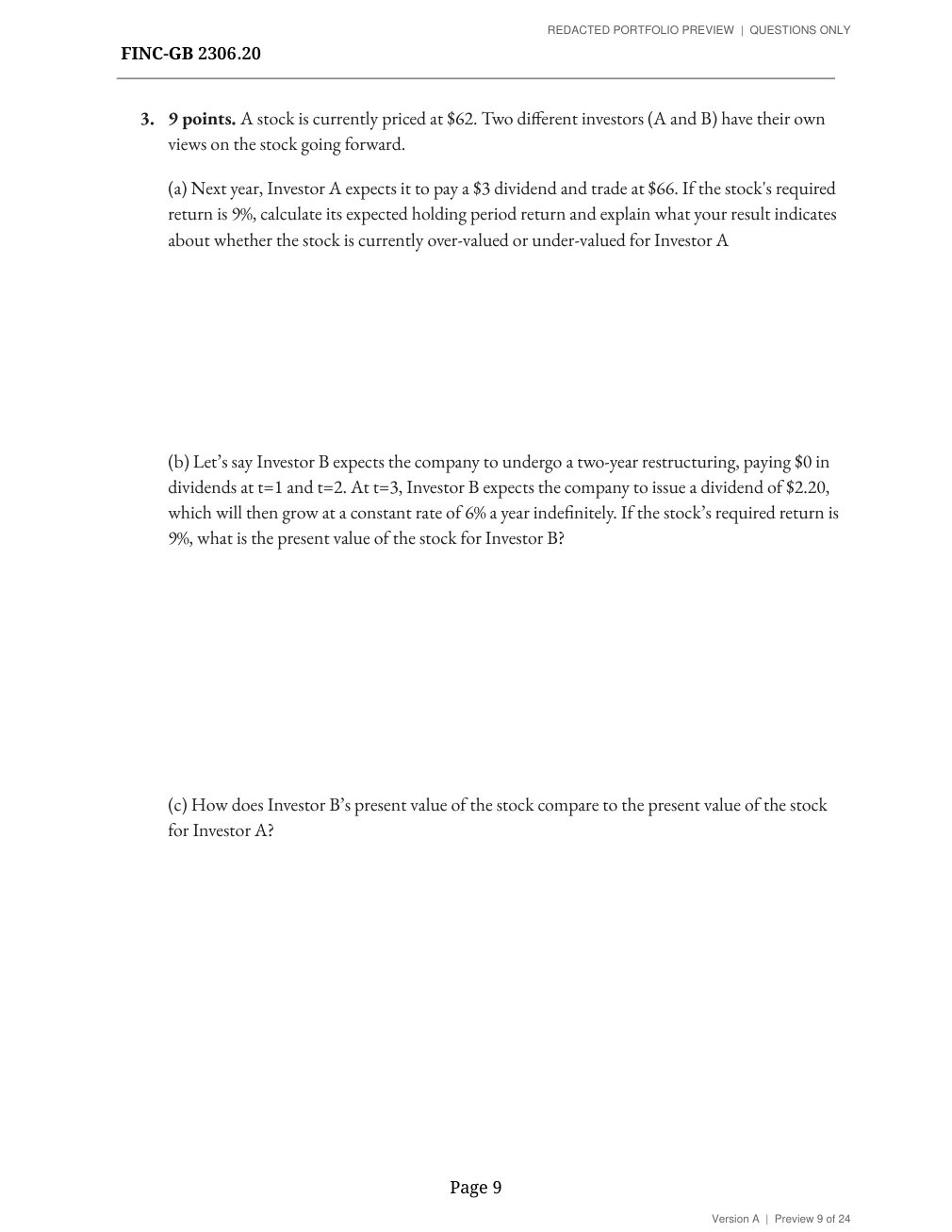
3. 9 points. A stock is currently priced at $62. Two different investors (A and B) have their own
views on the stock going forward.
(a) Next year, Investor A expects it to pay a $3 dividend and trade at $66. If the stock's required
return is 9%, calculate its expected holding period return and explain what your result indicates
about whether the stock is currently over-valued or under-valued for Investor A
(b) Let’s say Investor B expects the company to undergo a two-year restructuring, paying $0 in
dividends at t=1 and t=2. At t=3, Investor B expects the company to issue a dividend of $2.20,
which will then grow at a constant rate of 6% a year indefinitely. If the stock’s required return is
9%, what is the present value of the stock for Investor B?
(c) How does Investor B’s present value of the stock compare to the present value of the stock
for Investor A?
Page 9
REDACTED PORTFOLIO PREVIEW | QUESTIONS ONLY
Version A | Preview 9 of 24
FINC-GB 2306.20
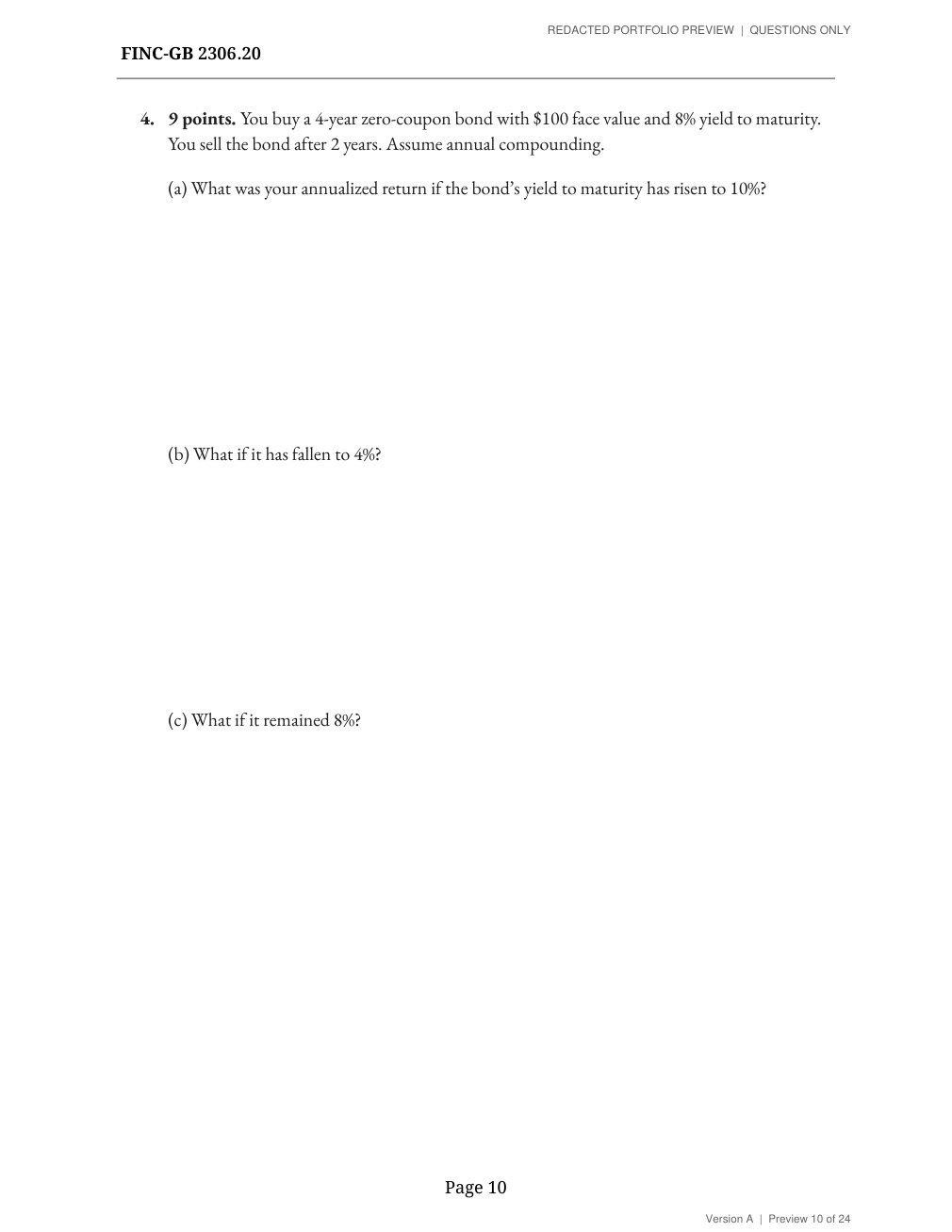
4. 9 points. You buy a 4-year zero-coupon bond with $100 face value and 8% yield to maturity.
You sell the bond after 2 years. Assume annual compounding.
(a) What was your annualized return if the bond’s yield to maturity has risen to 10%?
(b) What if it has fallen to 4%?
(c) What if it remained 8%?
Page 10
REDACTED PORTFOLIO PREVIEW | QUESTIONS ONLY
Version A | Preview 10 of 24
FINC-GB 2306.20
Page 11
5. 9 points. [Question omitted from public preview]
REDACTED PORTFOLIO PREVIEW | QUESTIONS ONLY
Version A | Preview 11 of 24
FINC-GB 2306.20
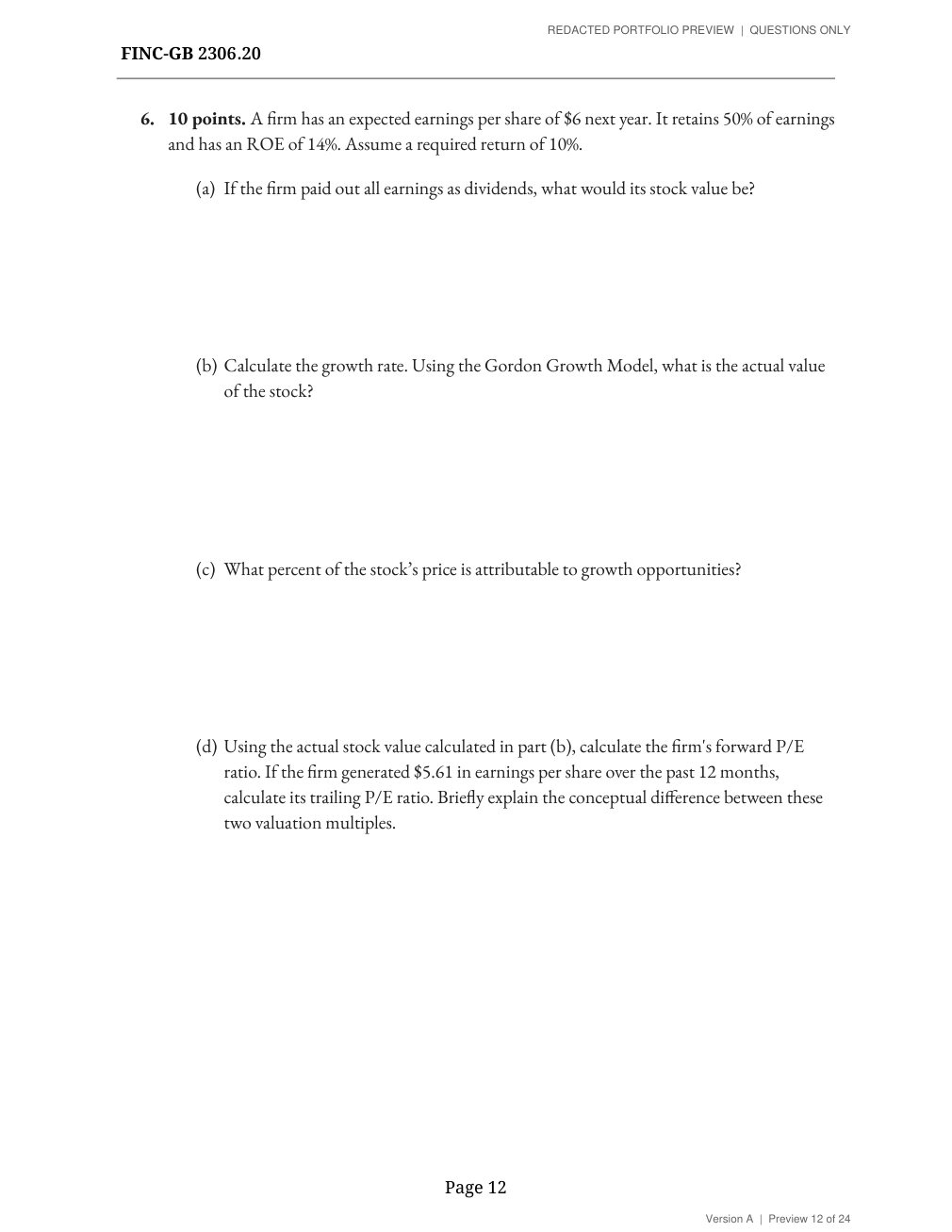
6. 10 points. A firm has an expected earnings per share of $6 next year. It retains 50% of earnings
and has an ROE of 14%. Assume a required return of 10%.
(a) If the firm paid out all earnings as dividends, what would its stock value be?
(b) Calculate the growth rate. Using the Gordon Growth Model, what is the actual value
of the stock?
(c) What percent of the stock’s price is attributable to growth opportunities?
(d) Using the actual stock value calculated in part (b), calculate the firm's forward P/E
ratio. If the firm generated $5.61 in earnings per share over the past 12 months,
calculate its trailing P/E ratio. Briefly explain the conceptual difference between these
two valuation multiples.
Page 12
REDACTED PORTFOLIO PREVIEW | QUESTIONS ONLY
Version A | Preview 12 of 24
Version B

Read text version
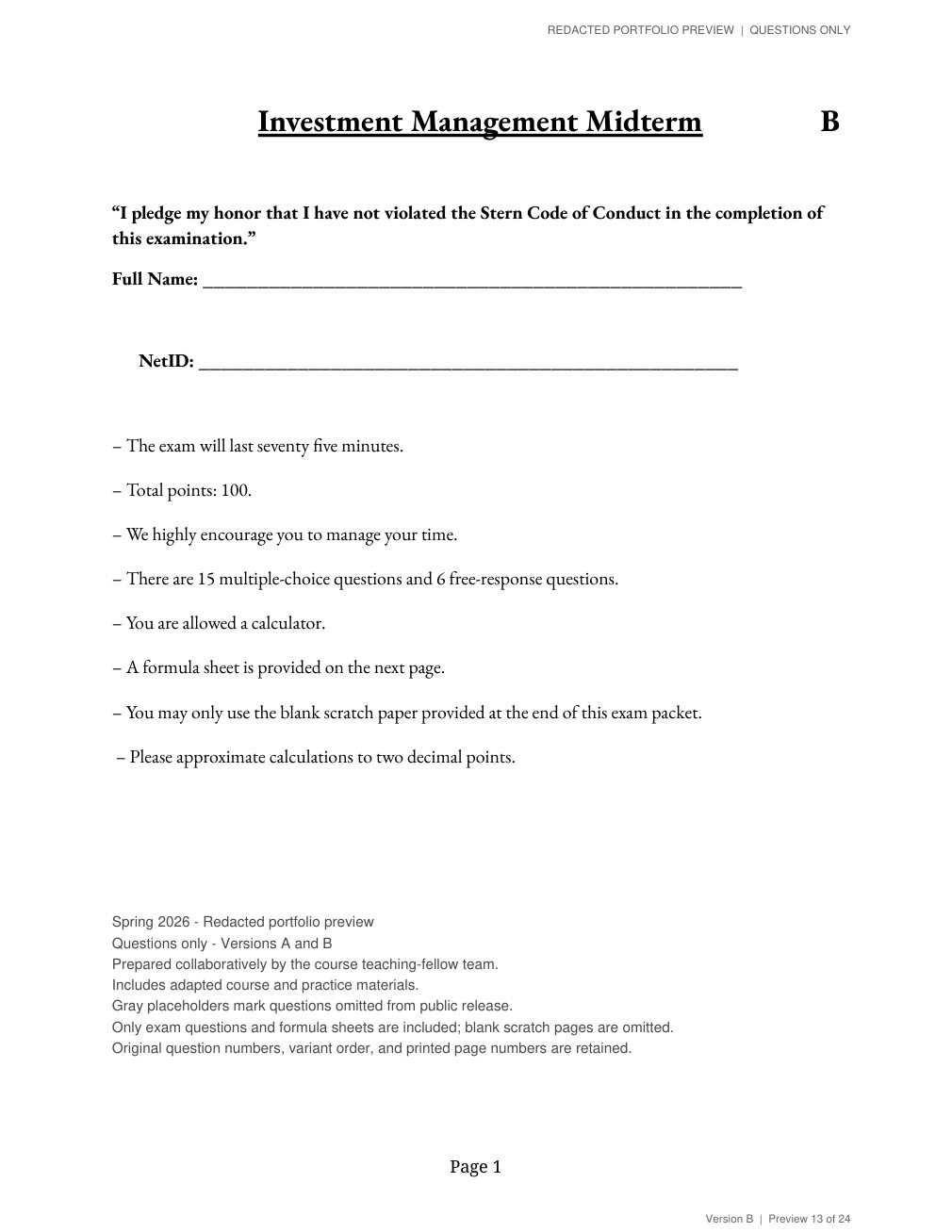
Investment Management Midterm B
“I pledge my honor that I have not violated the Stern Code of Conduct in the completion of
this examination.”
Full Name: _________________________________________________
NetID: _________________________________________________
– The exam will last seventy five minutes.
– Total points: 100.
– We highly encourage you to manage your time.
– There are 15 multiple-choice questions and 6 free-response questions.
– You are allowed a calculator.
– A formula sheet is provided on the next page.
– You may only use the blank scratch paper provided at the end of this exam packet.
– Please approximate calculations to two decimal points.
Page 1
Spring 2026 - Redacted portfolio preview
Questions only - Versions A and B
Prepared collaboratively by the course teaching-fellow team.
Includes adapted course and practice materials.
Gray placeholders mark questions omitted from public release.
Only exam questions and formula sheets are included; blank scratch pages are omitted.
Original question numbers, variant order, and printed page numbers are retained.
REDACTED PORTFOLIO PREVIEW | QUESTIONS ONLY
Version B | Preview 13 of 24
FINC-GB 2306.20
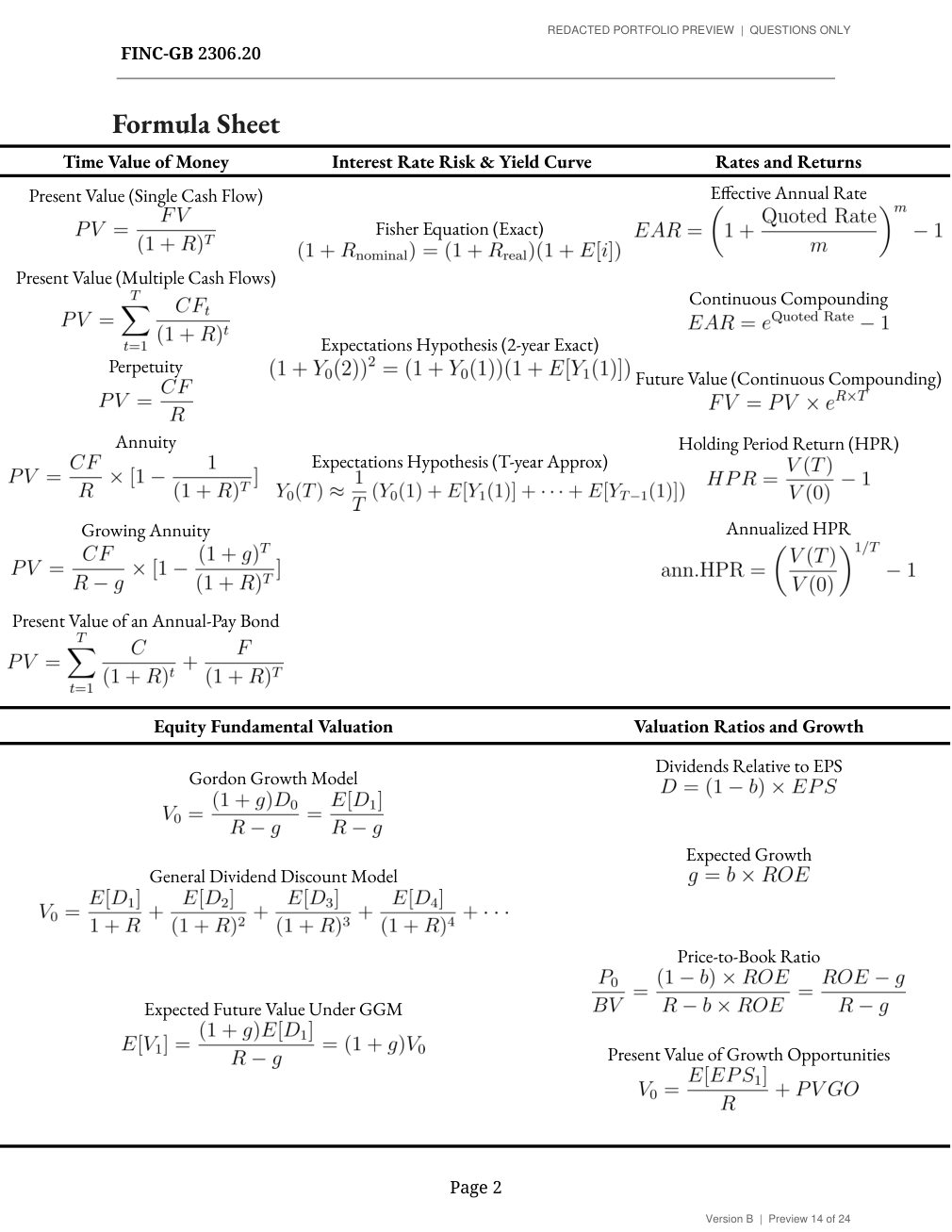
Formula Sheet
Time Value of Money
Interest Rate Risk & Yield Curve
Rates and Returns
Present Value (Single Cash Flow)
Fisher Equation (Exact)
Effective Annual Rate
Present Value (Multiple Cash Flows)
Expectations Hypothesis (2-year Exact)
Continuous Compounding
Perpetuity
Future Value (Continuous Compounding)
Annuity
Expectations Hypothesis (T-year Approx)
Holding Period Return (HPR)
Growing Annuity
Annualized HPR
Present Value of an Annual-Pay Bond
Equity Fundamental Valuation
Valuation Ratios and Growth
Gordon Growth Model
Dividends Relative to EPS
General Dividend Discount Model
Expected Growth
Expected Future Value Under GGM
Price-to-Book Ratio
Present Value of Growth Opportunities
Page 2
REDACTED PORTFOLIO PREVIEW | QUESTIONS ONLY
Version B | Preview 14 of 24
FINC-GB 2306.20
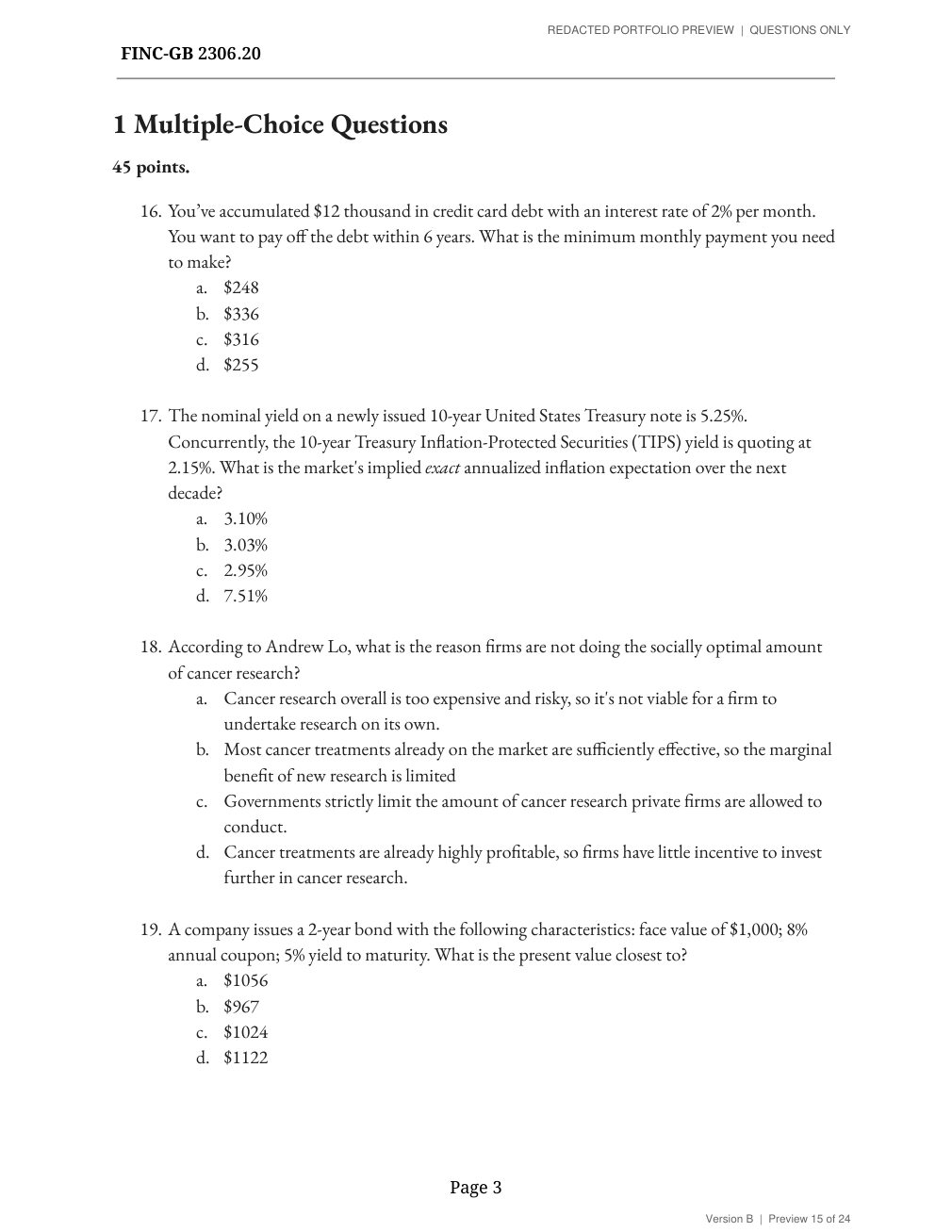
1 Multiple-Choice Questions
45 points.
16.You’ve accumulated $12 thousand in credit card debt with an interest rate of 2% per month.
You want to pay off the debt within 6 years. What is the minimum monthly payment you need
to make?
a. $248
b. $336
c. $316
d. $255
17.The nominal yield on a newly issued 10-year United States Treasury note is 5.25%.
Concurrently, the 10-year Treasury Inflation-Protected Securities (TIPS) yield is quoting at
2.15%. What is the market's implied exact annualized inflation expectation over the next
decade?
a. 3.10%
b. 3.03%
c. 2.95%
d. 7.51%
18.According to Andrew Lo, what is the reason firms are not doing the socially optimal amount
of cancer research?
a. Cancer research overall is too expensive and risky, so it's not viable for a firm to
undertake research on its own.
b. Most cancer treatments already on the market are sufficiently effective, so the marginal
benefit of new research is limited
c. Governments strictly limit the amount of cancer research private firms are allowed to
conduct.
d. Cancer treatments are already highly profitable, so firms have little incentive to invest
further in cancer research.
19.A company issues a 2-year bond with the following characteristics: face value of $1,000; 8%
annual coupon; 5% yield to maturity. What is the present value closest to?
a. $1056
b. $967
c. $1024
d. $1122
Page 3
REDACTED PORTFOLIO PREVIEW | QUESTIONS ONLY
Version B | Preview 15 of 24
FINC-GB 2306.20
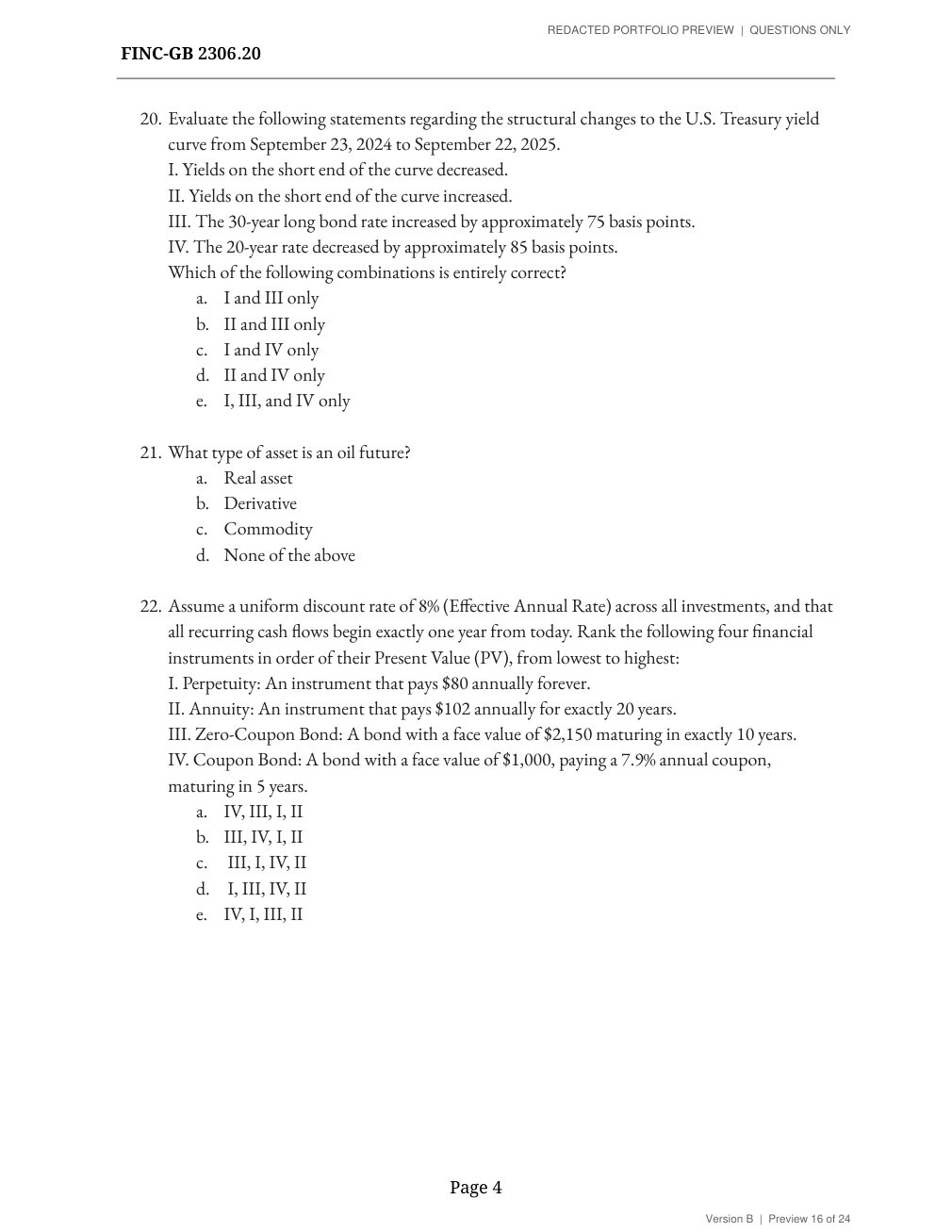
20.Evaluate the following statements regarding the structural changes to the U.S. Treasury yield
curve from September 23, 2024 to September 22, 2025.
I. Yields on the short end of the curve decreased.
II. Yields on the short end of the curve increased.
III. The 30-year long bond rate increased by approximately 75 basis points.
IV. The 20-year rate decreased by approximately 85 basis points.
Which of the following combinations is entirely correct?
a. I and III only
b. II and III only
c. I and IV only
d. II and IV only
e. I, III, and IV only
21.What type of asset is an oil future?
a. Real asset
b. Derivative
c. Commodity
d. None of the above
22.Assume a uniform discount rate of 8% (Effective Annual Rate) across all investments, and that
all recurring cash flows begin exactly one year from today. Rank the following four financial
instruments in order of their Present Value (PV), from lowest to highest:
I. Perpetuity: An instrument that pays $80 annually forever.
II. Annuity: An instrument that pays $102 annually for exactly 20 years.
III. Zero-Coupon Bond: A bond with a face value of $2,150 maturing in exactly 10 years.
IV. Coupon Bond: A bond with a face value of $1,000, paying a 7.9% annual coupon,
maturing in 5 years.
a. IV, III, I, II
b. III, IV, I, II
c. III, I, IV, II
d. I, III, IV, II
e. IV, I, III, II
Page 4
REDACTED PORTFOLIO PREVIEW | QUESTIONS ONLY
Version B | Preview 16 of 24
FINC-GB 2306.20
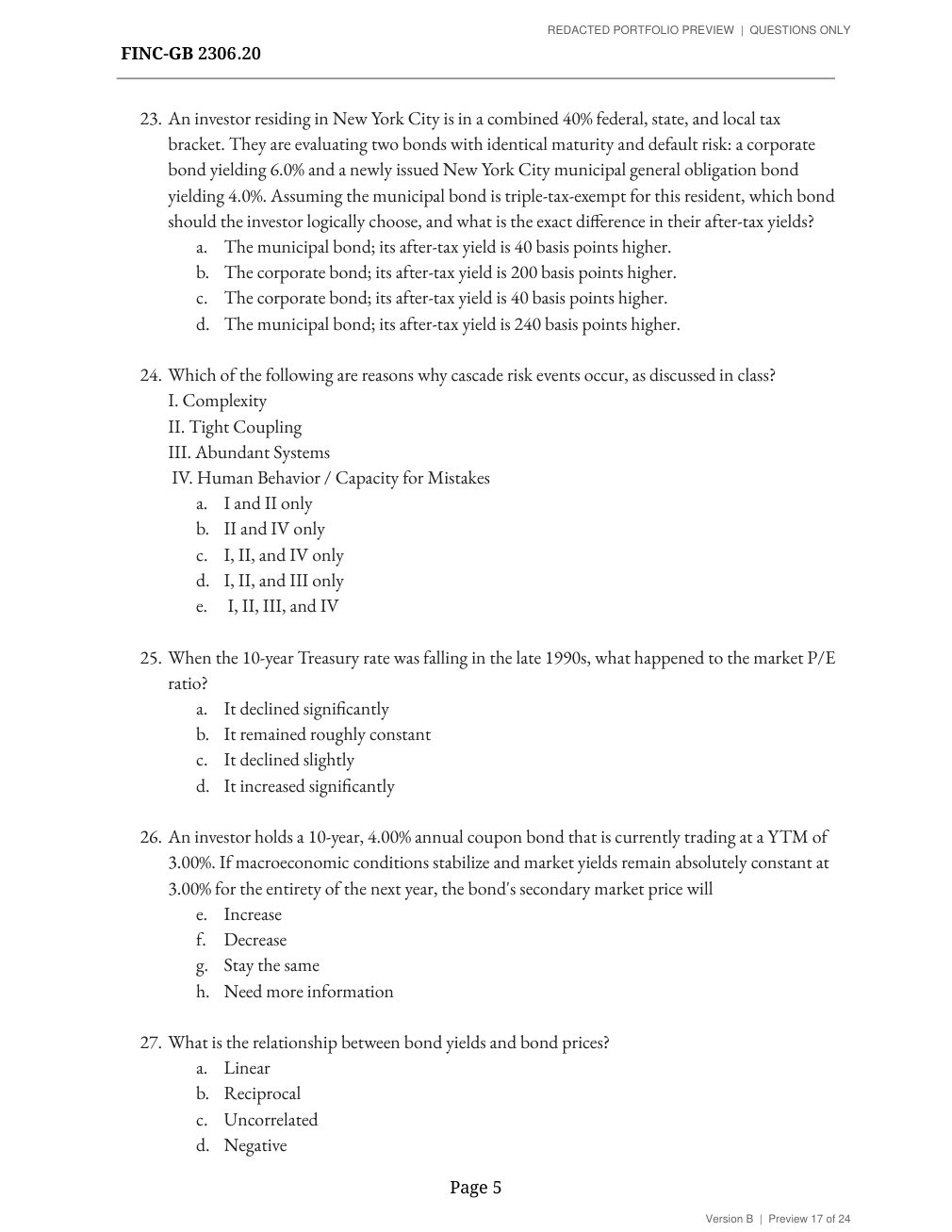
23.An investor residing in New York City is in a combined 40% federal, state, and local tax
bracket. They are evaluating two bonds with identical maturity and default risk: a corporate
bond yielding 6.0% and a newly issued New York City municipal general obligation bond
yielding 4.0%. Assuming the municipal bond is triple-tax-exempt for this resident, which bond
should the investor logically choose, and what is the exact difference in their after-tax yields?
a. The municipal bond; its after-tax yield is 40 basis points higher.
b. The corporate bond; its after-tax yield is 200 basis points higher.
c. The corporate bond; its after-tax yield is 40 basis points higher.
d. The municipal bond; its after-tax yield is 240 basis points higher.
24.Which of the following are reasons why cascade risk events occur, as discussed in class?
I. Complexity
II. Tight Coupling
III. Abundant Systems
IV. Human Behavior / Capacity for Mistakes
a. I and II only
b. II and IV only
c. I, II, and IV only
d. I, II, and III only
e. I, II, III, and IV
25.When the 10-year Treasury rate was falling in the late 1990s, what happened to the market P/E
ratio?
a. It declined significantly
b. It remained roughly constant
c. It declined slightly
d. It increased significantly
26.An investor holds a 10-year, 4.00% annual coupon bond that is currently trading at a YTM of
3.00%. If macroeconomic conditions stabilize and market yields remain absolutely constant at
3.00% for the entirety of the next year, the bond's secondary market price will
e. Increase
f. Decrease
g. Stay the same
h. Need more information
27.What is the relationship between bond yields and bond prices?
a. Linear
b. Reciprocal
c. Uncorrelated
d. Negative
Page 5
REDACTED PORTFOLIO PREVIEW | QUESTIONS ONLY
Version B | Preview 17 of 24
FINC-GB 2306.20
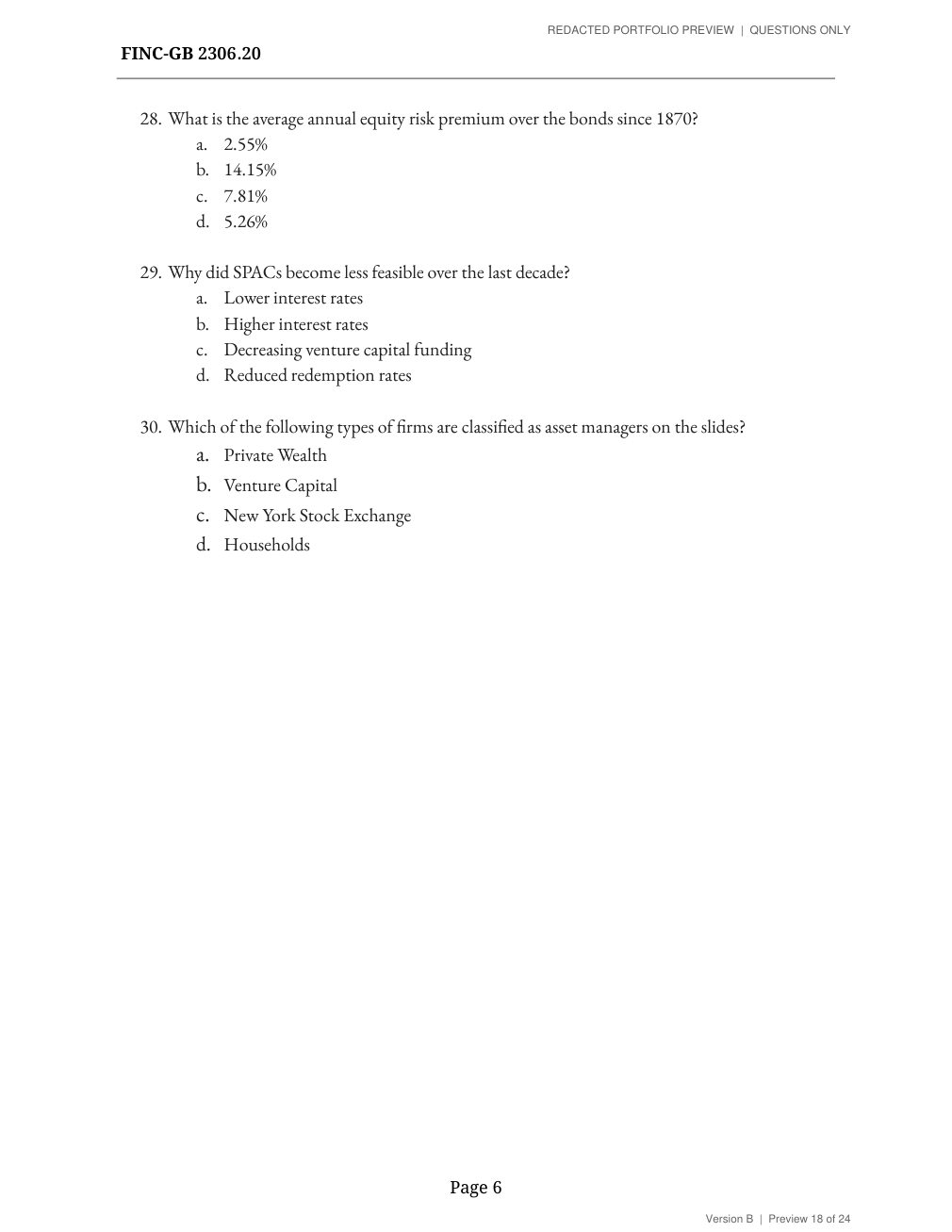
28.What is the average annual equity risk premium over the bonds since 1870?
a. 2.55%
b. 14.15%
c. 7.81%
d. 5.26%
29.Why did SPACs become less feasible over the last decade?
a. Lower interest rates
b. Higher interest rates
c. Decreasing venture capital funding
d. Reduced redemption rates
30.Which of the following types of firms are classified as asset managers on the slides?
a. Private Wealth
b. Venture Capital
c. New York Stock Exchange
d. Households
Page 6
REDACTED PORTFOLIO PREVIEW | QUESTIONS ONLY
Version B | Preview 18 of 24
FINC-GB 2306.20
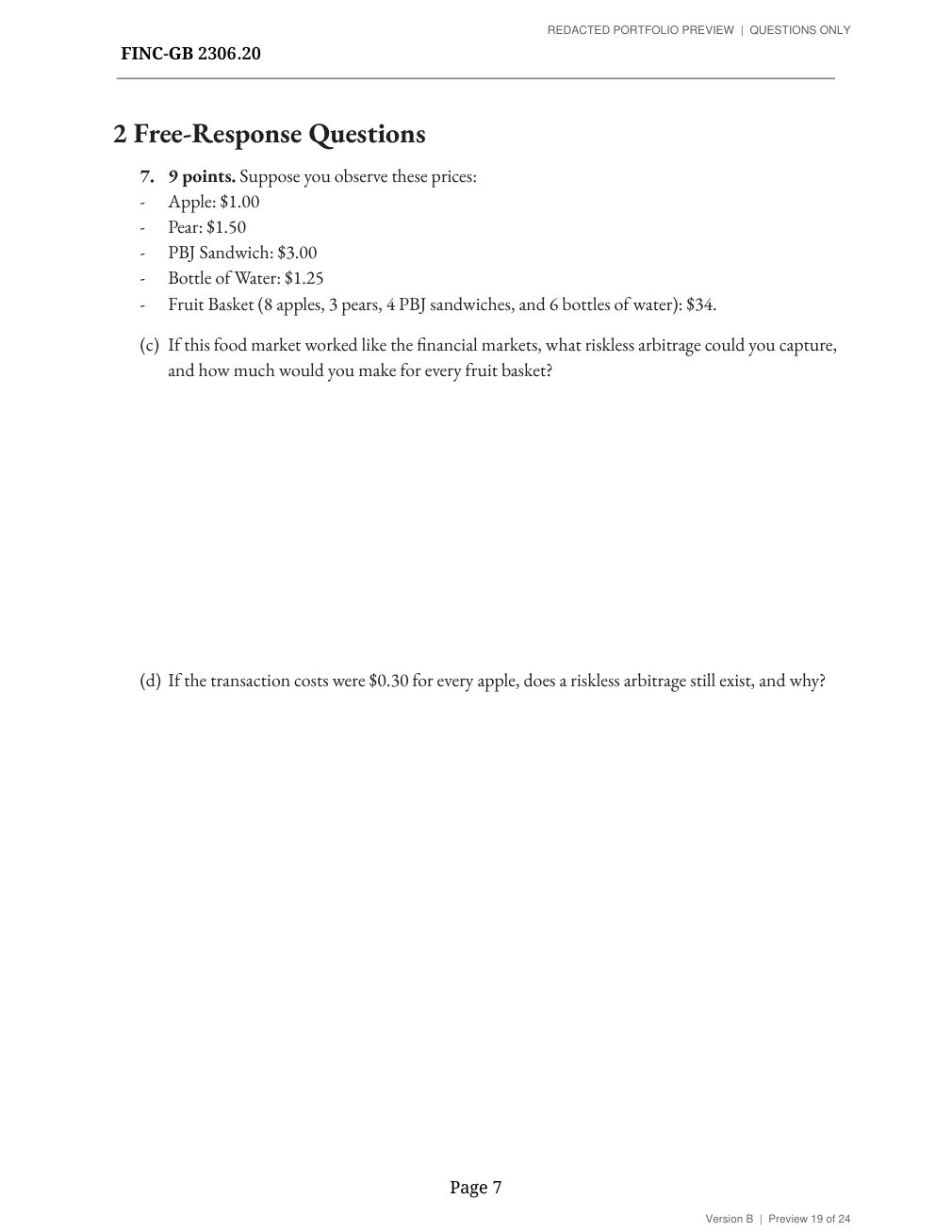
2 Free-Response Questions
7. 9 points. Suppose you observe these prices:
-
Apple: $1.00
-
Pear: $1.50
-
PBJ Sandwich: $3.00
-
Bottle of Water: $1.25
-
Fruit Basket (8 apples, 3 pears, 4 PBJ sandwiches, and 6 bottles of water): $34.
(c) If this food market worked like the financial markets, what riskless arbitrage could you capture,
and how much would you make for every fruit basket?
(d) If the transaction costs were $0.30 for every apple, does a riskless arbitrage still exist, and why?
Page 7
REDACTED PORTFOLIO PREVIEW | QUESTIONS ONLY
Version B | Preview 19 of 24
FINC-GB 2306.20
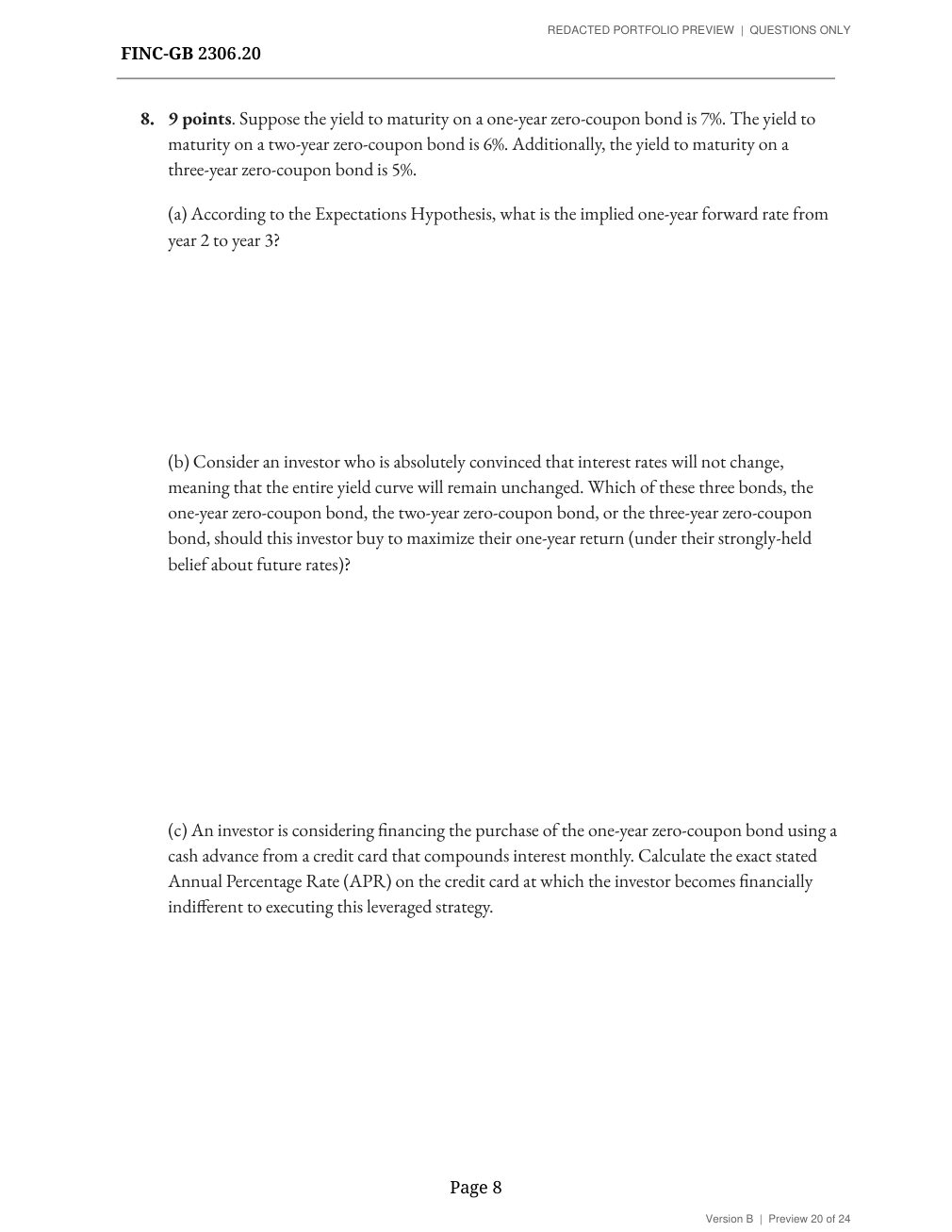
8. 9 points. Suppose the yield to maturity on a one-year zero-coupon bond is 7%. The yield to
maturity on a two-year zero-coupon bond is 6%. Additionally, the yield to maturity on a
three-year zero-coupon bond is 5%.
(a) According to the Expectations Hypothesis, what is the implied one-year forward rate from
year 2 to year 3?
(b) Consider an investor who is absolutely convinced that interest rates will not change,
meaning that the entire yield curve will remain unchanged. Which of these three bonds, the
one-year zero-coupon bond, the two-year zero-coupon bond, or the three-year zero-coupon
bond, should this investor buy to maximize their one-year return (under their strongly-held
belief about future rates)?
(c) An investor is considering financing the purchase of the one-year zero-coupon bond using a
cash advance from a credit card that compounds interest monthly. Calculate the exact stated
Annual Percentage Rate (APR) on the credit card at which the investor becomes financially
indifferent to executing this leveraged strategy.
Page 8
REDACTED PORTFOLIO PREVIEW | QUESTIONS ONLY
Version B | Preview 20 of 24
FINC-GB 2306.20
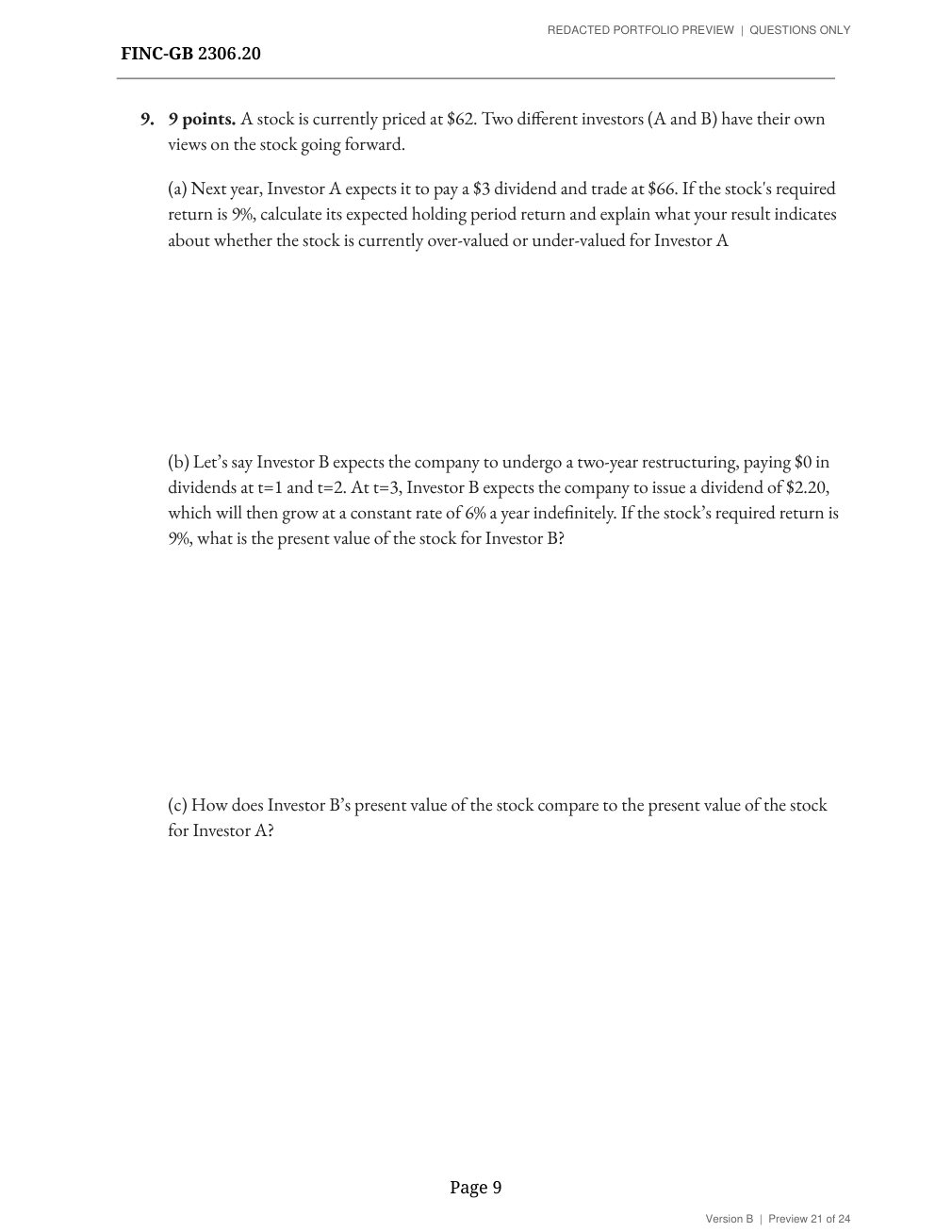
9. 9 points. A stock is currently priced at $62. Two different investors (A and B) have their own
views on the stock going forward.
(a) Next year, Investor A expects it to pay a $3 dividend and trade at $66. If the stock's required
return is 9%, calculate its expected holding period return and explain what your result indicates
about whether the stock is currently over-valued or under-valued for Investor A
(b) Let’s say Investor B expects the company to undergo a two-year restructuring, paying $0 in
dividends at t=1 and t=2. At t=3, Investor B expects the company to issue a dividend of $2.20,
which will then grow at a constant rate of 6% a year indefinitely. If the stock’s required return is
9%, what is the present value of the stock for Investor B?
(c) How does Investor B’s present value of the stock compare to the present value of the stock
for Investor A?
Page 9
REDACTED PORTFOLIO PREVIEW | QUESTIONS ONLY
Version B | Preview 21 of 24
FINC-GB 2306.20
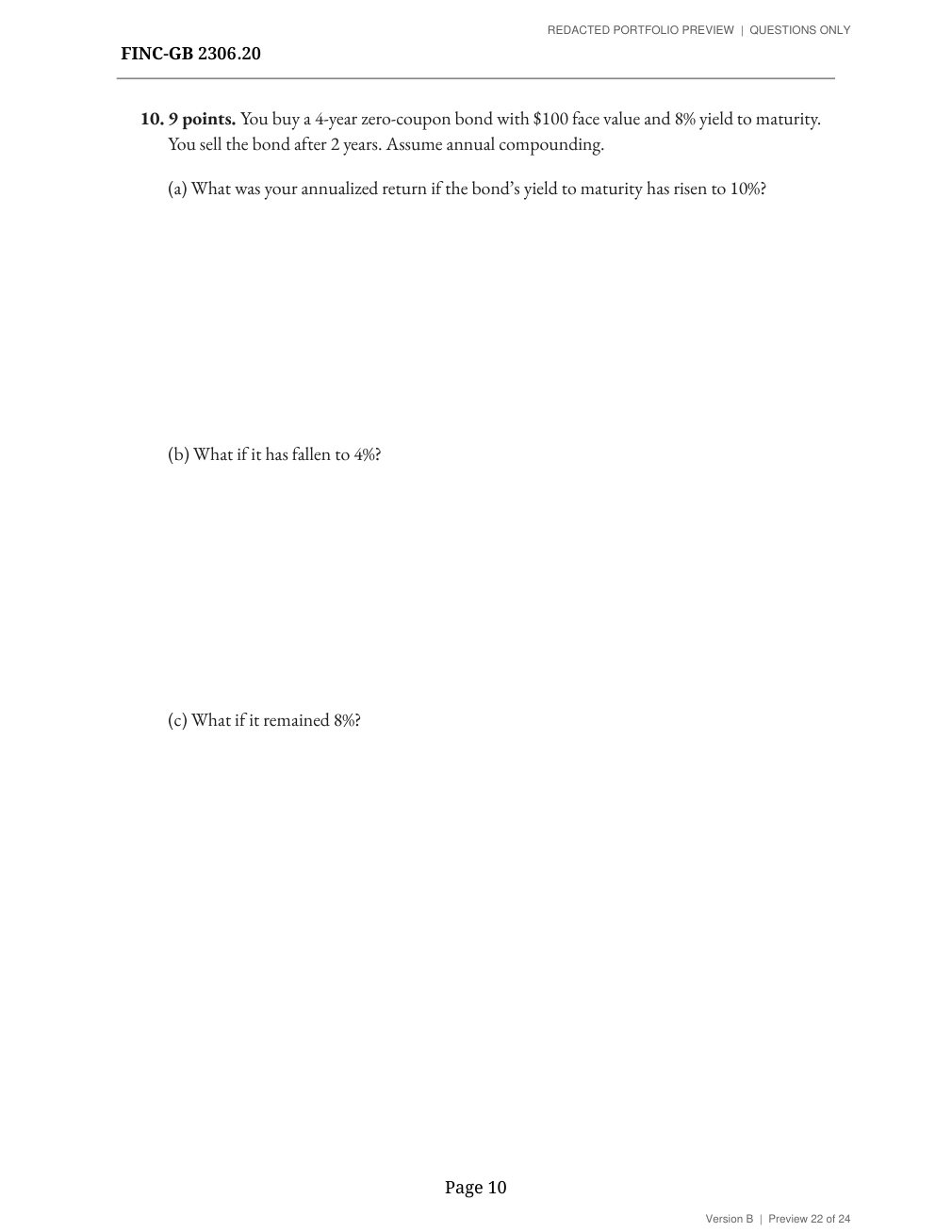
10.9 points. You buy a 4-year zero-coupon bond with $100 face value and 8% yield to maturity.
You sell the bond after 2 years. Assume annual compounding.
(a) What was your annualized return if the bond’s yield to maturity has risen to 10%?
(b) What if it has fallen to 4%?
(c) What if it remained 8%?
Page 10
REDACTED PORTFOLIO PREVIEW | QUESTIONS ONLY
Version B | Preview 22 of 24
FINC-GB 2306.20
Page 11
11. 9 points. [Question omitted from public preview]
REDACTED PORTFOLIO PREVIEW | QUESTIONS ONLY
Version B | Preview 23 of 24
FINC-GB 2306.20
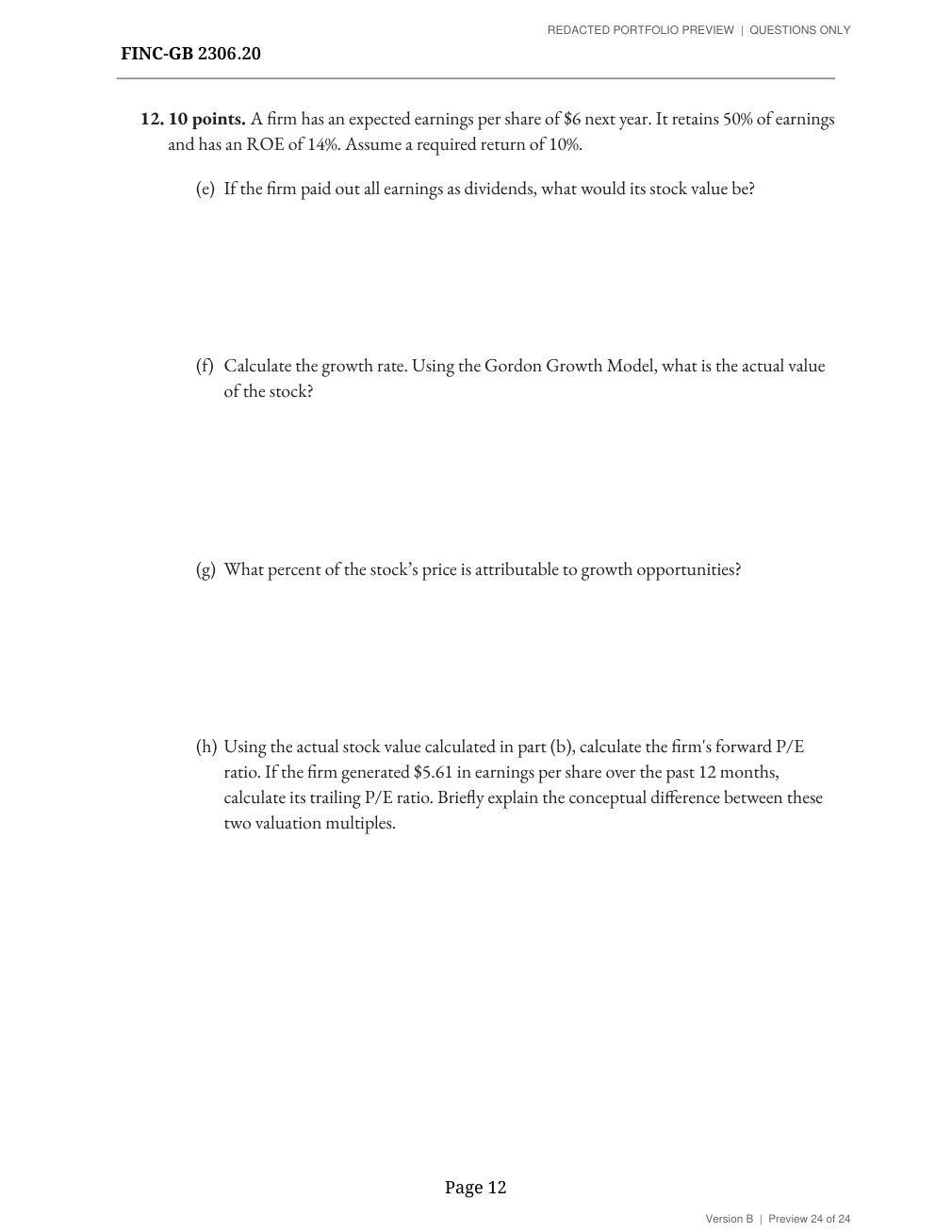
12.10 points. A firm has an expected earnings per share of $6 next year. It retains 50% of earnings
and has an ROE of 14%. Assume a required return of 10%.
(e) If the firm paid out all earnings as dividends, what would its stock value be?
(f) Calculate the growth rate. Using the Gordon Growth Model, what is the actual value
of the stock?
(g) What percent of the stock’s price is attributable to growth opportunities?
(h) Using the actual stock value calculated in part (b), calculate the firm's forward P/E
ratio. If the firm generated $5.61 in earnings per share over the past 12 months,
calculate its trailing P/E ratio. Briefly explain the conceptual difference between these
two valuation multiples.
Page 12
REDACTED PORTFOLIO PREVIEW | QUESTIONS ONLY
Version B | Preview 24 of 24